At 1:42 a.m. on December 19, 2020, Donald
Trump—disturbed, humiliated, livid—posted the following message on
Twitter: “Statistically impossible to have lost the 2020 Election. Big
protest in D.C. on January 6th. Be there, will be wild!”
In California, David Nicholas Dempsey, a 33-year-old man-child with
multiple felony convictions and a profound affection for the president,
answered the call. On January 6, wearing a tactical vest and an
American-flag gaiter, Dempsey came to the Capitol. Shortly before he
assaulted several police officers, he shared his perspectives in an
interview given while standing near a gallows. The gallows had been
erected as a reminder to Vice President Mike Pence to do, in Trump’s
words, “the right thing.”
“Them worthless fucking shitholes like fucking Jerry Nadler, fucking
Pelosi, Clapper, Comey, fucking all those pieces of garbage, you know,
Obama, all these dudes, Clinton, fuck all these pieces of shit,” Dempsey
said. “They don’t need a jail cell. They need to hang from these
motherfuckers while everybody videotapes it and fucking spreads it on
YouTube.”
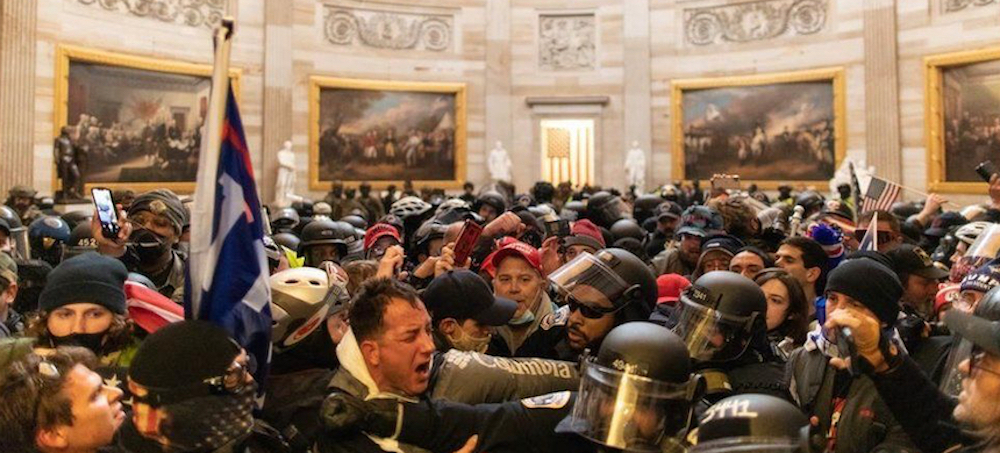
Dempsey was not an organizer of the siege, but he was one of its most energetic participants. He assaulted Metropolitan Police Detective Phuson Nguyen with pepper spray. Nguyen was certain in that moment that he was “going to die,”
he later testified.
Dempsey assaulted another police officer with a
metal crutch, cracking his protective shield and cutting his head.
Dempsey, who was heard yelling “Fuck you, bitch-ass cops!,” assaulted
other officers with broken pieces of furniture, crutches, and a
flagpole.
Prosecutors would later argue that “Dempsey’s violence reached
such extremes that, at one point, he attacked a fellow rioter who was
trying to disarm him.” All told, more than 140 police officers were
injured in the riot, many seriously.
I attended the January 6 rally on the Ellipse,
at which Trump told his supporters, “If you don’t fight like hell,
you’re not going to have a country anymore.” Then I walked with the
crowd to the Capitol. One woman, a QAnon adherent dressed in a cat
costume, told me, “We’re going to stop the steal. If Pence isn’t going
to stop it, we have to.”
What I remember very well about that day was my own failure of
imagination. I did not, to my knowledge, see Dempsey—he had positioned
himself at the vanguard of the assault, and I had stayed near the White
House to listen to Trump—but I did come across at least a dozen or more
protesters dressed in similar tactical gear or wearing body armor, many
of them carrying flex-cuffs. I particularly remember those plastic
cuffs, but I understood them only as a performance of zealous
commitment. Later we would learn that these men—some of whom were Proud
Boys—believed that they would actually be arresting members of Congress
in defense of the Constitution. I interviewed one of them. “It’s all in
the Bible,” he said. “Everything is predicted. Donald Trump is in the
Bible.” Grifters could not exist, of course, without a population primed
to be grifted.
After the riot, Dempsey returned to California, where he was
eventually arrested. In early 2024, he pleaded guilty to two felony
counts of assaulting an officer with a dangerous weapon. He was sentenced to 20 years in prison.
Six months later, in the summer of 2024, Trump, who would come to
describe the January 6 insurrection as a “day of love,” said that, if
reelected, he would pardon rioters, but only “if they’re innocent.”
Dempsey was not innocent, but on January 20, 2025, shortly after being
inaugurated, Trump pardoned him and roughly 1,500 others charged with or
convicted of offenses related to the Capitol insurrection. (Fourteen
people, mainly senior figures in the Oath Keepers and Proud Boys
movements, saw their sentences commuted but did not receive pardons.)
Of the 1,500 or so offenders who received pardons, roughly 600 had
been charged with assaulting or obstructing police officers, and 170 had
been accused of using deadly weapons in the siege. Among those pardoned
were Peter Schwartz, who had received a 14-year sentence for throwing a
chair at police officers and repeatedly attacking them with pepper
spray; Daniel Joseph Rodriguez, who was sentenced to 12.5 years for
conspiracy and assaulting an officer with a stun gun (he sent a text
message to a friend, “Tazzzzed the fuck out of the blue”); and Andrew
Taake, who received a six-year sentence for attacking officers with bear
spray and a metal whip.
A day after the pardons were announced, Trump said in a press
conference, “I am a friend of police, more than any president who’s been
in office.” He went on to describe the rioters. “These were people that
actually love our country, so we thought a pardon would be
appropriate.”
trump had something else to say during that first press conference of
his new term: “I think we’re going to do things that people will be
shocked at.” This would turn out to be true, but unfortunately, shock
does not last. Here is the emblematic inner struggle of our age: to
preserve the ability to be shocked. “Man grows used to everything, the
scoundrel!” Dostoyevsky wrote. A blessing that is also a curse.
I understand that a review—even a short and partial review—of the
past year might seem dismally repetitive. But repetition ensures that we
remember, and perhaps even experience shock anew.
So, in brief: Trump has dismantled America’s foreign-aid
infrastructure and gutted a program, built by an earlier Republican
president, that saved the lives of Africans infected with HIV; he has
encouraged the United States military to commit war crimes; he has
instituted radical cuts to U.S. science and medical funding and abetted a
crusade against vaccines; he has appointed conspiracists, alcoholics,
and idiots to key positions in his administration; he has destroyed the
independence of the Justice Department; he has waged pitiless war on
prosecutors, FBI agents, and others who previously investigated him, his
family, and his friends; he has cast near-fatal doubt on America’s
willingness to fulfill its treaty obligations to its democratic allies;
he has applauded Vladimir Putin for his barbarism and castigated Ukraine
for its unwillingness to commit suicide; he has led racist attacks on
various groups of immigrants; he has employed unusually cruel tactics in
pursuit of undocumented immigrants, most of whom have committed only
one crime—illegally seeking refuge in a country that they believed
represented the dream of a better life. Those are some of the actions
Trump has taken. Here are a few of the things he has said since
returning to office: He has referred to immigrants as “garbage”; he has
called a female reporter “piggy” and other reporters “ugly,” “stupid,”
“terrible,” and “nasty”; he has suggested that the murder of a Saudi
journalist by his country’s government was justified; he has labeled a
sitting governor “seriously retarded”; he has blamed the murder of Rob
Reiner on the director’s anti-Trump politics; he has called the
Democrats the party of “evil.”
Yet, even when weighed against this stunning record of degeneracy,
the pardoning by Trump of his cop-beating foot soldiers represents the
lowest moment of this presidency so far, because it was an act not only
of naked despotism but also of outlandish hypocrisy. By pardoning these
criminals, he exposed a foundational lie of MAGA ideology: that it
stands with the police and as a guarantor of law and order. The truth is
the opposite.
The power to pardon is a vestige of America’s pre-independence past.
It is an unchecked monarchical power, an awesome power, and therefore it
should be bestowed only on leaders blessed with self-restraint,
civic-mindedness, and, most important, basic decency.
We have been watching indecency triumph in the public sphere on and
off for more than 10 years now, since the moment Trump insulted John
McCain’s war record. For reasons that are quite possibly too unbearable
to contemplate, a large group of American voters was not repulsed by
such slander—they were actually aroused by it—and our politics have not
been the same.
Much has been said, including by me, about Trump’s
narcissism, his autocratic inclinations, his disconnection from reality,
but not nearly enough has been said about his fundamental indecency,
the characteristic that undergirds everything he says and does.
In an important essay, Andrew Sullivan noted this past fall that Trump’s indecency is comprehensive in style and substance.
“It is one thing to be a realist in foreign policy, to accept the
morally ambiguous in an immoral world; it is simply indecent to treat a
country, Ukraine, invaded by another, Russia, as the actual aggressor
and force it to accept a settlement on the invader’s terms,” Sullivan
wrote.
“It is one thing to find and arrest illegal immigrants; it is
indecent to mock and ridicule them, and send them with no due process to
a foreign gulag where torture is routine. It is one thing to enforce
immigration laws; it is another to use masked, anonymous men to do it.
It is one thing to cut foreign aid; it is simply indecent to do so
abruptly and irrationally so that tens of thousands of children will
needlessly die. We have slowly adjusted to this entirely new culture
from the top, perhaps in the hope that it will somehow be sated soon—but
then new indecencies happen.”
The subject of Trump’s indecency came up in a conversation I had with
Barack Obama in 2017. I asked him to name the most norm-defying act of
his successor to date. Somewhat to my surprise, Obama mentioned Trump’s speech at the Boy Scouts’ National Jamboree
earlier that year. This appearance has been largely forgotten, but it
was a festival of indecency. At one point, Trump told the scouts about a
wealthy friend of his who, he suggested, did unmentionable things on
his yacht.
Obama, a model of dignified presidential behavior (just like nearly
all of his predecessors, Democratic and Republican), understood
viscerally the importance of self-restraint and adherence to
long-established norms. Which is why he was so troubled by Trump’s
decadent performance. “You can stand in front of tens of thousands of
teenage boys and encourage them to be good citizens and be helpful to
their mothers,” Obama said, “or you can go Lord of the Flies. He went
Lord of the Flies.”
We are in a long Lord of the Flies moment, led by a man who, to
borrow from Psalm 10, possesses a mouth “full of cursing and deceit and
fraud.” For many people—government scientists seeking cures for
diseases; FBI agents investigating corruption and terrorism; military
leaders trying to preserve respect for the rules of warfare; and, in
particular, police officers who were brutalized by Trump’s army of
deluded followers—these days can seem infernal.
Trump’s term is
one-quarter over; a piece of advice often attributed to Churchill has it
best: When you’re going through hell, keep going.
They differ in name only.