Monday, January 22, 2024

In 2024, Trump voters are motivated by one thing above all: Irrational revenge

 PICKENS, SOUTH CAROLINA - JULY 01: Supporters of former President Donald Trump wave signs during a campaign event on July 1, 2023 in Pickens, South Carolina. The former president faces a growing list of primary challengers in the Republican Party.  (Photo by Sean Rayford/Getty Images)

By Dartagnan

Community 

Daily Kos

REPUBLISHED BY:

Blue Country Gazette Blog

Rim Country Gazette Blog

Americans typically frame their politics as a contest between “right” and “wrong.” In our two-party system today, voters usually believe both they and their party are completely in the right, while those on the opposite side are completely wrong. And this belief persists even after one side concedes defeat: Yes, my party lost the election, but your party is still wrong.

There’s nothing unusual about this. Americans have generally viewed elections that way since the founding of the republic. One side is invariably left unhappy with the result, but they’ll invariably lick their wounds, galvanize behind a new candidate, and try again next time. There’s usually been no burning sense of resentment, no designs of revenge held against the voters who repudiated their decision the last time around. When Barack Obama beat John McCain in 2008, Democratic voters didn’t want “revenge” on McCain voters. That was just the way things were in those halcyon days.

Until Donald Trump, that is. Trump himself has been soundly and decisively dismissed by most Americans. He was repudiated by multiple impeachments that he richly deserved, and emphatically rejected by an electoral and popular majority of American voters in the 2020 election. Now, in 2024—amidst a swirling maelstrom of serious legal and criminal charges against him—Trump has made revenge the central focus of his campaign.  He’s still insisting to his supporters that his 2020 loss was fake (it wasn’t), and that they’ve been insidiously victimized by some type of amorphous, pervasive fraud and Democratic chicanery that essentially played them for fools. It’s a con that Trump started cultivating well before the 2020 election itself, that only went into overdrive after his failed coup of Jan. 6, 2021. 

As Tom Nichols, writing for The Atlantic, observes, the Republican electorate has swallowed Trump’s fiction and internalized it. Republicans have transformed Trump’s embarrassments into an insult against their own personal identities and belief systems. It’s an offense that demands and necessitates revenge against those fellow Americans who dared to insult them.  

RELATED STORY: A reelected Trump would mean living under the constant threat of modern-day Brownshirts

As Nichols observes:

These voters are not settling a political score. Rather, they want to get even with other Americans, their own neighbors, for a simmering (and likely unexpected) humiliation that many of them seem to have felt ever since swearing loyalty to Trump.

A lot of people, especially in the media, have a hard time accepting this simple truth. Millions of Americans, stung by the electoral rebukes of their fellow citizens, have become so resentful and detached from reality that they have plunged into a moral void, a vortex that disintegrates questions of politics or policies and replaces them with heroic fantasies of redeeming a supposedly fallen nation.

It’s terribly difficult and gut-wrenching to admit that one’s choices were wrong. For some people, it’s impossible. For voters who fatefully cast their lot with Trump (and have been subjected over and over to glaring examples of his unfitness), there is no way to save face but by “plunging into that moral void,” as Nichols puts it.

They have to ignore Trump’s 91 criminal charges and his wholesale moral bankruptcy. They have to invent preposterous stories about President Joe Biden and his family. They have to believe, Nichols points out, that violence may be the only path to get their way—and it’s all to salvage their own sorry egos from the unforgivable slight of being wrong. So, egged on by their media bubble and abjectly Trump-dependent political leaders, these voters invent horrors that don't exist, imagine dire threats that they'll never personally face, and conjure up enemies they'll never encounter. It's all, as Nichols seems to imply, a coping mechanism to internally justify their own bad choice.

MESA, ARIZONA - OCTOBER 09:  Former U.S. President Donald Trump gestures to the crowd as he arrives at the podium for a campaign rally at Legacy Sports USA on October 09, 2022 in Mesa, Arizona. Trump was stumping for Arizona GOP candidates, including gubernatorial nominee Kari Lake, ahead of the midterm election on November 8.  (Photo by Mario Tama/Getty Images)
He wants revenge, and so do his supporters.

But, Nichols asks, against whom are they seeking violence and revenge? Why, Democrats, of course. Those neighbors who had that Biden-Harris 2020 sign have left them seething for four years, as has the local election board that processed all those mail-in votes. As Nichols observes, “When people talk about ‘resorting to violence’ they are, by default, talking about violence against their fellow citizens, some of whom have already been threatened merely for working in their communities as election volunteers.”

Unlike in previous elections, the motivation of these Trump loyalists isn’t really about policy, and it’s not really about “the border” or trans kids. It’s about a sense of revenge that Trump has cynically, deliberately cultivated in them. So they can finally come out on top.

As Nichols writes:

Much like Trump himself, these voters are unable to accept what’s happened over the past several years. Trump, in so many ways, quickly made fools of them; his various inanities, failures, and possible crimes sent them scrambling for ever more bizarre rationalizations, defenses of the indefensible that separated them from family and friends. If in 2016 they suspected, rightly or wrongly, that many Americans looked down on them for any number of reasons, they now know with certainty that millions of people look down on them—not for who they are but for what they’ve supported so vocally.

Nichols—a conservative, adamant “never-Trumper”—gets it mostly right here about Trump’s base, but he omits an important fact: that “what they’ve supported so vocally” is in fact quite telling about “who they are.” Still, he effectively dispenses with all the time and pixels wasted by major media in trying to “understand”—via visits to homey small-town diners and such—Trump voters’ motivations, ostensibly in the vain hope “that more listening and more empathetic nodding would put things right in a few years.”

That time has mercifully passed. Assuming Nichols is right, then there’s precious little to be gained by trying to understand Trump voters or ascribe any rationality to them. Revenge is a raw human emotion, not something that can be dealt with through discourse or reason. As Nichols cogently explains, more than anything, Donald Trump’s loyal base wants revenge “on their fellow citizens” for their attacks, critiques, and disparagement of Donald Trump.

No doubt they’ll be sorely disappointed when they don’t get it.

Which of Trump's loyal supporters will you be inviting to your home for Thanksgiving dinner?

Sunday, January 21, 2024

Irreverent Donald Trump is filling the God-shaped hole in Republicans’ lives

 no image description available  

Scraggly MAGA attendees listen to the opening prayer during a campaign event for Donald Trump on Dec. 19, 2023, in Waterloo, Iowa.

For many Americans who consider themselves Christian, it seems impossible to square the behavior of Donald Trump with any form of the religion they hold dear. It’s not just that Trump has little understanding of the core tenets of Christianity or its roots in Judaism: It’s that Trump’s actions seem to be the polar opposite of everything Christians are supposed to believe.

This is a man who has made vengeance the core of his latest election campaign. Whose philosophy is to return any blow 10 times over. Who regularly calls for violence, on levels large and small. A man who is eager to kill people by the thousands. Who declares that those who refuse to follow his every order deserve death. And that’s before even dipping into a personal life filled with accusations of fraud, adultery, theft, and rape.

Where Jesus said, “I am the resurrection and the life,” Trump declares, “I am your retribution.” How can anyone who claims to follow one of these men support the other?

The answer, according to The New York Times, is simple: Trump supporters have redefined Christianity. For them, it has little to do with religion, and even less to do with Christ. Christianity is now just another synonym for MAGA.

That Republicans have long claimed a special position as the more religious party is no surprise. A quick look at the 1956 Republican Party platform shows a party that was already opening with a “declaration of faith” and an insistence that the “rights of men came from the Creator and not from the State.” By contrast, the Democratic Party platform in the same year opens with a “preamble” and is a lot more focused on the actions of the government than it is on celebrating their “creator.”

Still, no one party could claim any ownership of religious voters. Even after Ronald Reagan and his supporters essentially created the religious right in 1980, both parties continued to battle for religious voters based on issues, not on some presumption that one party was inherently more “godly.” Republicans worried about losing liberal mainstream Protestants when they tried to cut funding for social programs, while Democrats were aware that issues like abortion rights were costing them conservative churchgoers.

As the 20th century drew to a close, Democrats continued to maintain a toehold in even the most conservative churches. Bill Clinton, Al Gore, and Jimmy Carter were all Southern Baptists. Carter was a Sunday school teacher who authored several books on his Christian faith. Evangelical leader Franklin Graham might be incapable of separating his religion from Trump, but his father Billy Graham was a lifelong Democrat who warned against fully supporting any political leader (even if he did make his name by thumping his chest over those godless commies).

In the 2000 election, George W. Bush took the Protestant vote while Gore won Catholics (and Jews, and other faiths). In 2008, the same thing happened with John McCain and Barack Obama. Between those two elections, Democrats made gains with both Catholics and Protestants while also widening the gap with Americans who considered themselves unaffiliated with any religion.

But what’s happened in the past three decades, and especially in the Age of Trump, is very different. The number of Americans who no longer consider themselves affiliated with any religion has grown at an extraordinary rate. In 1992, America didn’t look much different than it did in 1972 (or 1952) when it came to religion. But by 2022, the number of Americans who called themselves Christian was just over two-thirds of what it had been when Clinton and George H. W. Bush faced off, according to polling from the Pew Research Center and the General Social Survey.

The percentage of Americans who consider themselves Christian is falling rapidly.

In the past few years, that change has accelerated sharply. And where earlier declines seem to have been largely felt by more progressive Protestant churches, recent “de-churching” has been felt most heavily on the right, among the same evangelical groups that have spent the last decades building megachurches and increasingly aligning themselves with Republican positions, according to The New York Times.

The percentage of Americans who call themselves Protestant—including evangelicals—has dropped from 70% in 1953 to 34% in 2022, according to Gallup. That’s a decline of more than 0.5% a year. Since 2016, the rate has averaged 0.67% a year.

In the past decade, the number of those who self-identify as evangelical has declined more rapidly than the still ongoing fall in numbers at more liberal churches. A larger share of conservatives than liberals report that they no longer attend any church. This is a big factor in pushing America’s total church membership below 50% for the first time since Pew or Gallup began their surveys.

If the rate continues to decline as dramatically as it has over the past six years, Protestantism will disappear in the United States in the next 50 years. Based on the Pew results, Christianity itself would vanish not long after.

Both of those scenarios are extremely unlikely. However, there is one group in Gallup’s poll on religion that has increased over the past two decades, and the nature of that category may explain a lot about what’s going on.

The one growing category (in addition to those unaffiliated with any religion, which is way up)  is people who report themselves as “Christian (nonspecific).” This was just 2% of the population in 1999. It’s 11% today. And “nonspecific” seems to match well with The New York Times’ description of Trump’s followers.

As the article makes clear, while church membership in the United States has been declining, many of those who no longer associate with any church still consider themselves Christian—though they seem to be a very different sort of Christian.

According to the U.S. Religion Census, church attendance in Iowa fell 13% in a decade—over twice as fast as the nation overall. Of those who still attend, many complain of an aging church population and the difficulty of bringing in young families when their children are involved in multiple activities. (On a personal note: This is exactly the issue afflicting my own church, where Sunday school is down to a handful of children, young families are very rare, and I’m practically a spring chicken. Church membership is aging, and you don’t have to peek in many pews to see that this is true.)

However, religious leaders continue to insist that even among those who have left an organized church, many still strongly identify as Christian. It doesn’t seem like too much of a stretch to suggest these people may be among the “nonspecific” Christians in Gallup’s polling: people who have become unmoored from any particular church, but still hang on to the label of the religion they knew as a child.

But even as churches have been shrinking, Trump has been surging, and in story after story, America is being told that Christians support Trump. Except … do they? Because what’s going on doesn’t really seem like Christianity at all.

Take the example of a retired corrections officer quoted in the Times article.

“I voted for Trump twice, and I’ll vote for him again. He’s the only savior I can see,”

Or this rather confusing statement from a former Sunday school teacher who now works in a slot machine parlor and says, “Trump is our David and our Goliath.”

Conservative theologians may be trying to draw connections between Trump and the Persian leader Cyrus the Great, who in the Bible is credited with freeing Jews from captivity and returning them to Jerusalem, but most Trump supporters aren’t nearly so esoteric. Trump is front and center in their beliefs.

Why has Jesus been ousted as the central character in many a “Christian’s” life in favor of Trump? As Ryan Burge, an associate professor of political science at Eastern Illinois University and a Baptist pastor, explained to The New York Times, “Politics has become the master identity. Everything else lines up behind partisanship.”

These are people for whom “Christian” is a label. It doesn’t mean they have any interest in understanding the tenets of Christianity as a religion: It means they follow Trump. And it helps to explain why so many pastors are willing to trade Jesus for Trump when standing at the pulpit.

“People who love their country and believe in God, but haven’t been typical churchgoers—he’s brought those people into the fold,” said Jackson Lahmeyer, the founder of Pastors for Trump, a national group of church leaders backing the former president.

These are pastors who have done just what the retired corrections officer and the slot machine attendant have done: replaced Jesus with Donald Trump. Only while Trump’s supporters may find that a vitriol-spitting bigot seems to fit the God-shaped holes in their hearts, Pastors for Trump have an even more crass and destructive reason. In the face of emptying churches, they’re willing to swap out crosses for MAGA hats in the hope it will put asses in the pews and dollars in the offering plates.

MIAMI, FLORIDA - JANUARY 03: Faith leaders pray over President Donald Trump during a 'Evangelicals for Trump' campaign event held at the King Jesus International Ministry on January 03, 2020 in Miami, Florida. The rally was announced after a December editorial published in Christianity Today called for the President Trump's removal from office. (Photo by Joe Raedle/Getty Images)
Faith leaders pray over Donald Trump during a 'Evangelicals for Trump' campaign event held at the King Jesus International Ministry on Jan. 3, 2020, in Miami, Florida. The rally was announced after a December editorial published in Christianity Today called for Trump's removal from office. 

The “Christian” label serves another purpose for Trump supporters: It allows them to play the victim. It gives them the right to be racist, misogynist, antisemitic, anti-Muslim, and anti-LGBTQ+ … then retreat behind religion if anyone points it out. It’s martyrdom in a box, always ready for instant deployment.

And if that means they have to trade a message of love, acceptance, and forgiveness for one of spite, anger, and violence … hey, does it matter? They’re Christians. You wouldn’t understand.

Just take this prayer from Joel Tenney, a “local evangelist” who doesn’t lead a church but opened for Trump at an Iowa rally.

“This election is part of a spiritual battle,” Mr. Tenney said. “When Donald Trump becomes the 47th president of the United States, there will be retribution against all those who have promoted evil in this country.”

Tenney might seem to be explicitly preaching against what followers of Christ are told to do. But that’s the old Christianity. The kind that doesn’t even own a gold-trimmed penthouse.

Not to be outdone by the Virgin Mary appearing on a tortilla, the Orange Lard shows up on toast.

Saturday, January 20, 2024

Secret Republican house commission working to cut Social Security you pay for

AlexLawsonSocialSecurityWorksExecDirconfrontsGOPcommitteetryingtocutSocialSecurity3.jpg

Social Security Works Executive Director Alex Lawson confronted the Republican-controlled House Budget Committee members in their hearing attempting to create a commission to cut Social Security.

By Egberto Willies

Community

Daily Kos

REPUBLISHED BY:

Blue Country Gazette Blog

Rim Country Gazette Blog

In a recent episode of "Politics Done Right," hosted by Egberto Willies, a critical and timely discussion unfolded with Alex Lawson, the Executive Director of Social Security Works. This insightful conversation illuminated the ongoing struggle to safeguard Social Security against attempts to undermine it, particularly from the GOP.

Lawson, a vanguard in the fight to protect Social Security, recently made headlines for his direct action in a congressional hearing. His efforts exemplify the vigilance required to defend this crucial program against insidious attempts at reduction or dismantling. The interview began with a congenial exchange, acknowledging the inclement weather in D.C., a subtle metaphor for the stormy political climate surrounding Social Security.

Willies set the stage, emphasizing the covert nature of the attacks on Social Security, often obscured from public scrutiny until it's potentially too late. This backdrop is essential for understanding the significance of Lawson's actions. He is not just an advocate but a watchman on the wall, alerting the public to hidden threats.

Lawson detailed the tactics employed by certain members of Congress, primarily those serving the interests of the billionaire class. He described their strategy of attempting to fast-track commissions to expedite cuts to Social Security, bypassing the normal legislative process, which offers multiple opportunities for public intervention. This approach, designed to exclude the American people's voice on matters concerning their own financial security, reveals a disturbing disregard for democratic principles.

Lawson brought attention to the overwhelming popularity of Social Security across the political spectrum. He highlighted the absurdity of the situation, where more people believe in the Loch Ness Monster than support cuts to Social Security benefits. This comparison underscores the disconnect between the public's wishes and the actions of certain politicians.

The focal point of Lawson's confrontation was the proposal of a "fast-track" commission, which he aptly termed a "smoky back room" tactic. This maneuver would strip the public of their right to have a say in the future of Social Security, consolidating decision-making power in the hands of a few, away from public scrutiny.

Lawson's bold move at the hearing was not just a symbolic gesture. He presented a petition signed by over half a million Americans, a tangible representation of widespread public opposition to any cuts to Social Security. This act of defiance was powerful, amplifying the voices of countless Americans who often feel unheard in the political process.

The interview took a critical turn as Lawson addressed the role of certain Democrats who, by supporting the commission, give a veneer of bipartisanship to what is essentially a GOP-led initiative. He specifically called out Earl Blumenauer, Scott Peters, and Jim Panetta, labeling them turncoats and emphasizing the need to hold them accountable. This part of the conversation was crucial, as it highlighted the complexity of the political landscape and the importance of vigilance even within one's own party.

Lawson's strategy is not solely about confrontation; it's about coalition-building and amplifying the collective voice of those who stand to be most affected by any changes to Social Security. He cited the involvement of over a hundred organizations and numerous congressional allies in this fight, showcasing a united front against the proposed commission.

The discussion concluded with a call to action, urging listeners to join the fight to protect Social Security. Lawson's message was clear: the power of the people is formidable, and when mobilized, it can counteract the influence of the wealthy few who seek to undermine the social safety net for their gain.

In summary, Alex Lawson's confrontation in the congressional hearing is a beacon of activism and advocacy. It highlights the ongoing struggle to protect Social Security from those who seek to dismantle it for ideological or financial reasons. His actions, along with the support of organizations and individuals nationwide, underscore the importance of vigilance and active participation in the democratic process to safeguard the rights and welfare of all Americans.

Our contributions more than cover the cost of Social Security.  The average American does not use all the money he or she contributed.  That is a proven fact!  Instead of cutting benefits the Republicans should be making their rich consorts pay their fair share.

Friday, January 19, 2024

You Should Go to a Trump Rally

 You Should Go to a Trump Rally  

For many Americans, the former president has become an abstraction. They should see for themselves what his campaign is really about. (photo: AFP)

 
For many Americans, the former president has become an abstraction. They should see for themselves what his campaign is really about.

Mckay Coppins / The Atlantic 

If Donald Trump has benefited from one underappreciated advantage this campaign season, it might be that no one seems to be listening to him very closely anymore.

This is a strange development for a man whose signature political talent is attracting and holding attention. Consider Trump’s rise to power in 2016—how all-consuming his campaign was that year, how one @realDonaldTrump tweet could dominate news coverage for days, how watching his televised stump speeches in a suspended state of fascination or horror or delight became a kind of perverse national pastime.

Now consider the fact that it’s been 14 months since Trump announced his entry into the 2024 presidential race. Can you quote a single thing he’s said on the campaign trail? How much of his policy agenda could you describe? Be honest: When was the last time you watched him speaking live, not just in a short, edited clip?

It’s not that Trump has been forgotten. He remains an omnipresent fact of American life, like capitalism or COVID-19. Everyone is aware of him; everyone has an opinion. Most people would just rather not devote too much mental energy to the subject. This dynamic has shaped Trump’s third bid for the presidency. As Katherine Miller recently observed in The New York Times, “The path toward his likely renomination feels relatively muted, as if the country were wandering through a mist, only to find ourselves back where we started, except older and wearier, and the candidates the same.”

Perhaps we overlearned the lessons of that first Trump campaign. After he won, a consensus formed among his detractors that the news media had given him too much airtime, allowing him to set the terms of the debate and helping to “normalize” his rhetoric and behavior.

But if the glut of attention in 2016 desensitized the nation to Trump, the relative dearth in the past year has turned him into an abstraction. The major cable-news networks don’t take his speeches live like they used to, afraid that they’ll be accused of amplifying his lies. He’s skipped every one of the GOP primary debates. And since Twitter banned him in January 2021, his daily fulminations have remained siloed in his own obscure social-media network, Truth Social. These days, Trump exists in many Americans’ minds as a hazy silhouette—formed by preconceived notions and outdated impressions—rather than as an actual person who’s telling the country every day who he is and what he plans to do with a second term.

To rectify this problem, I propose a 2024 resolution for politically engaged Americans: Go to a Trump rally. Not as a supporter or as a protester, necessarily, but as an observer. Take in the scene. Talk to his fans. Listen to every word of the Republican front-runner’s speech. This might sound unpleasant to some; consider it an act of civic hygiene.

Yes, there are other ways to familiarize yourself with the candidate and the stakes of this election. (And, of course, some people might not feel safe at a Trump event.) But nothing quite captures the Trump ethos like his campaign rallies. This has been true ever since he held his first one at Trump Tower, in June 2015. Back then, he had to stack the crowd with paid actors, prompting many in the press (myself included) to dismiss the whole thing as an astroturf marketing stunt. But the rallies, like the campaign itself, soon took on a life of their own, with thousands of people flocking to Phoenix or Toledo or Daytona Beach to witness the once-in-a-generation spectacle firsthand. What would he do? What would he say? I still remember the night of the 2016 Nevada caucuses, standing in line for Trump’s victory rally at the Treasure Island Hotel and Casino and overhearing one gawker enthuse to another, “This is a cultural phenomenon. We have to see it.”

Regardless of your personal orientation toward Trump, attending one of his rallies will be a clarifying experience. You’ll get a tactile sense of the man who’s dominated American politics for nearly a decade, and of the movement he commands. People who comment on politics for a living—journalists, academics—might find certain premises challenged, or at least complicated. Opponents and activists might come away with new urgency (and maybe a dash of empathy for the people Trump has under his sway). The experience could be especially educational to Republican voters who are not Trump devotees but who see the other GOP candidates as lost causes and plan to vote for Trump over Joe Biden. Surely, they should see, before they cast their vote, what exactly they’re voting for.

I recently undertook this challenge myself. As a reporter, I’ve covered about 100 Trump rallies in my life. For a stretch in the fall of 2016, I spent more time in MAGAfied arenas and airplane hangars than I did sleeping in my own bed. What I remember most from that year is the unsettling, anything-might-happen quality of the events. The chaos. The violence. The glee of the candidate presiding over it all.

But with the commencement of a new election year, it occurred to me that I hadn’t been to a rally since 2019. The pandemic, followed by a book project and a series of story assignments unrelated to Trump, had kept me largely off the campaign trail. I was curious what it would be like to go back. Had anything changed? Was my impression of Trump still up-to-date? So, one night earlier this month, I parked my rental car on a scrap of frozen grass near the North Iowa Events Center in Mason City and made my way inside.

A line had formed hours before Trump was scheduled to speak, but the people trickling in from the cold through metal detectors were in good spirits. They chatted amiably about their holiday travel and arranged themselves in groups for selfies. An upbeat soundtrack played over the speakers—Michael Jackson, Adele, Panic! at the Disco—and people excitedly pointed out recognizable faces in the media section. “You’re that guy from CBS!” one attendee exclaimed to a TV-news correspondent.

I found the wholesome, church-barbecue vibe a little jarring. For months, my impression of the 2024 Trump campaign had been shaped by the apocalyptic rhetoric of the candidate himself—the stuff about Marxist “vermin” destroying America, and immigrants “poisoning the blood of our country.” The people here didn’t look like they were bracing for an existential catastrophe. Had I overestimated the radicalizing effect of Trump’s rhetoric?

Only once I started talking to attendees did I detect the darker undercurrent I remembered from past rallies.

I met Kris, a 71-year-old retired nurse in orthopedic sneakers, standing near the press risers. (She declined to share her last name.) She was smiley and spoke in a sweet, grandmotherly voice as she told me how she’d watched dozens of Trump rallies, streaming them on Rumble or FrankSpeech, a platform launched by the right-wing MyPillow founder Mike Lindell. (She waited until Lindell, who happened to be loitering near us, was out of earshot to confide that she preferred Rumble.) The conversation was friendly and unremarkable—until it turned to the 2020 election, which Kris told me she believes was “most definitely” stolen.

“You think Trump should still be president?” I asked.

“By all means,” she said. “And I think behind the scenes he maybe is doing a little more than what we know about.”

“What do you mean?”

“Military-wise,” she said. “The military is supposed to be for the people, against tyrannical governments,” she went on to explain. “I hope he’s guiding the military to be able to step in and do what they need to do. Because right now, I’d say government’s very tyrannical.” If the Democrats try to steal the election again in 2024, she told me, the Trump-sympathetic elements of the military might need to seize control.

Around 8 p.m., Trump took the stage and launched into his remarks, toggling back and forth between what he called “teleprompter stuff” (his prepared stump speech) and the unscripted riffs that he’s famous for. Seeing him speak in this setting after so many years was strange—both instantly familiar and still somehow shocking, like rewatching an old movie you saw a hundred times as a kid but whose most offensive jokes you’d forgotten.

When he talked about members of the Biden administration, he referred to them as “idiots” and “lunatics” and “bad people.” When he talked about the “invasion” of undocumented immigrants at the southern border, he punctuated the riff with ominous warnings for his mostly white audience: “They’re occupying schools …They’re sitting with your children.” When he mentioned Barack Obama, he made a point of using the former president’s middle name—“Barack Hussein Obama”—and then veered off into an appreciation of Rush Limbaugh, the late conservative talk-radio host who taught him this trick. “We miss Rush,” Trump said to enthusiastic cheers. “We need you, Rush!”

I’d forgotten how casually he swears from the podium—deriding, at one point, his Republican rival Nikki Haley’s recent statement on the Civil War as “three paragraphs of bullshit”—and how casually people in the crowd swear back. Throughout the speech, two young men near the front repeatedly screamed “Fuck Biden!” prompted a wave of naughty giggles from others in the crowd.

If one thing has noticeably changed since 2016, it’s how the audience reacts to Trump. During his first campaign, the improvised material was what everyone looked forward to, while the written sections felt largely like box-checking. But in Mason City, the off-script riffs—many of which revolved around the 2020 election being stolen from him, and his personal sense of martyrdom—often turned rambly, and the crowd seemed to lose interest. At one point, a woman in front of me rolled her eyes and muttered, “He’s just babbling now.” She left a few minutes later, joining a steady stream of early exiters, and I wondered then whether even the most loyal Trump supporters might be surprised if they were to see their leader speak in person.

My own takeaway from the event was that there’s a reason Trump is no longer the cultural phenomenon he was in 2016. Yes, the novelty has worn off. But he also seems to have lost the instinct for entertainment that once made him so interesting to audiences. He relies on a shorthand legible only to his most dedicated followers, and his tendency to get lost in rhetorical cul-de-sacs of self-pity and anger wears thin. This doesn’t necessarily make him less dangerous. There is a rote quality now to his darkest rhetoric that I found more unnerving than when it used to command wall-to-wall news coverage.

These were my own impressions of the rally I attended; yours may very well be different. The only way to know is to see for yourself. Every four years, pundits try to identify the medium that will shape the presidential race—the “Twitter election,” the “cable-news election.” In 2024, with both parties warning of existential stakes for America, perhaps the best approach is to simply show up in real life.

Shortly before Trump began speaking, I met a friendly young dad in glasses who’d brought his 6-year-old son to the event. He’d never attended a Trump rally before and was excited to be there. When I asked if I could chat with him after Trump’s speech to see what he thought of the event, he happily agreed.

As Trump spoke, I glanced over at the man a few times from the press section. His expression was muted; he barely reacted to the lines that drove the crowd wild. The longer Trump spoke, I noticed, the further the man drifted backward toward the exits. Of course, I don’t know what was going through his head. Maybe he was just a stoic type. Or maybe his enthusiasm was tempered by the distraction of tending to a 6-year-old. All I know is that, halfway through the speech, he was gone.


Thursday, January 18, 2024

In 2024, Trump voters are motivated by one thing above all: Revenge


PICKENS, SOUTH CAROLINA - JULY 01: Supporters of former President Donald Trump wave signs during a campaign event on July 1, 2023 in Pickens, South Carolina. The former president faces a growing list of primary challengers in the Republican Party.  (Photo by Sean Rayford/Getty Images)

By Dartagnan

Community

Daily Kos

REPUBLISHED BY:

Blue Country Gazette Blog

Rim Country Gazette Blog

Americans typically frame their politics as a contest between “right” and “wrong.” In our two-party system today, voters usually believe both they and their party are completely in the right, while those on the opposite side are completely wrong. And this belief persists even after one side concedes defeat: Yes, my party lost the election, but your party is still wrong.

There’s nothing unusual about this. Americans have generally viewed elections that way since the founding of the republic. One side is invariably left unhappy with the result, but they’ll invariably lick their wounds, galvanize behind a new candidate, and try again next time. There’s usually been no burning sense of resentment, no designs of revenge held against the voters who repudiated their decision the last time around. When Barack Obama beat John McCain in 2008, Democratic voters didn’t want “revenge” on McCain voters. That was just the way things were in those halcyon days.

Until Donald Trump, that is. Trump himself has been soundly and decisively dismissed by most Americans. He was repudiated by multiple impeachments that he richly deserved, and emphatically rejected by an electoral and popular majority of American voters in the 2020 election. Now, in 2024—amidst a swirling maelstrom of serious legal and criminal charges against him—Trump has made revenge the central focus of his campaign.  He’s still insisting to his supporters that his 2020 loss was fake (it wasn’t), and that they’ve been insidiously victimized by some type of amorphous, pervasive fraud and Democratic chicanery that essentially played them for fools. It’s a con that Trump started cultivating well before the 2020 election itself, that only went into overdrive after his failed coup of Jan. 6, 2021. 

As Tom Nichols, writing for The Atlantic, observes, the Republican electorate has swallowed Trump’s fiction and internalized it. Republicans have transformed Trump’s embarrassments into an insult against their own personal identities and belief systems. It’s an offense that demands and necessitates revenge against those fellow Americans who dared to insult them.  

RELATED STORY: A reelected Trump would mean living under the constant threat of modern-day Brownshirts

As Nichols observes:

These voters are not settling a political score. Rather, they want to get even with other Americans, their own neighbors, for a simmering (and likely unexpected) humiliation that many of them seem to have felt ever since swearing loyalty to Trump.

A lot of people, especially in the media, have a hard time accepting this simple truth. Millions of Americans, stung by the electoral rebukes of their fellow citizens, have become so resentful and detached from reality that they have plunged into a moral void, a vortex that disintegrates questions of politics or policies and replaces them with heroic fantasies of redeeming a supposedly fallen nation.

It’s terribly difficult and gut-wrenching to admit that one’s choices were wrong. For some people, it’s impossible. For voters who fatefully cast their lot with Trump (and have been subjected over and over to glaring examples of his unfitness), there is no way to save face but by “plunging into that moral void,” as Nichols puts it.

They have to ignore Trump’s 91 criminal charges and his wholesale moral bankruptcy. They have to invent preposterous stories about President Joe Biden and his family. They have to believe, Nichols points out, that violence may be the only path to get their way—and it’s all to salvage their own sorry egos from the unforgivable slight of being wrong. So, egged on by their media bubble and abjectly Trump-dependent political leaders, these voters invent horrors that don't exist, imagine dire threats that they'll never personally face, and conjure up enemies they'll never encounter. It's all, as Nichols seems to imply, a coping mechanism to internally justify their own bad choice.

MESA, ARIZONA - OCTOBER 09:  Former U.S. President Donald Trump gestures to the crowd as he arrives at the podium for a campaign rally at Legacy Sports USA on October 09, 2022 in Mesa, Arizona. Trump was stumping for Arizona GOP candidates, including gubernatorial nominee Kari Lake, ahead of the midterm election on November 8.  (Photo by Mario Tama/Getty Images)
He wants revenge, and so do his supporters.

But, Nichols asks, against whom are they seeking violence and revenge? Why, Democrats, of course. Those neighbors who had that Biden-Harris 2020 sign have left them seething for four years, as has the local election board that processed all those mail-in votes. As Nichols observes, “When people talk about ‘resorting to violence’ they are, by default, talking about violence against their fellow citizens, some of whom have already been threatened merely for working in their communities as election volunteers.”

Unlike in previous elections, the motivation of these Trump loyalists isn’t really about policy, and it’s not really about “the border” or trans kids. It’s about a sense of revenge that Trump has cynically, deliberately cultivated in them. So they can finally come out on top.

As Nichols writes:

Much like Trump himself, these voters are unable to accept what’s happened over the past several years. Trump, in so many ways, quickly made fools of them; his various inanities, failures, and possible crimes sent them scrambling for ever more bizarre rationalizations, defenses of the indefensible that separated them from family and friends. If in 2016 they suspected, rightly or wrongly, that many Americans looked down on them for any number of reasons, they now know with certainty that millions of people look down on them—not for who they are but for what they’ve supported so vocally.

Nichols—a conservative, adamant “never-Trumper”—gets it mostly right here about Trump’s base, but he omits an important fact: that “what they’ve supported so vocally” is in fact quite telling about “who they are.” Still, he effectively dispenses with all the time and pixels wasted by major media in trying to “understand”—via visits to homey small-town diners and such—Trump voters’ motivations, ostensibly in the vain hope “that more listening and more empathetic nodding would put things right in a few years.”

That time has mercifully passed. Assuming Nichols is right, then there’s precious little to be gained by trying to understand Trump voters or ascribe any rationality to them. Revenge is a raw human emotion, not something that can be dealt with through discourse or reason. As Nichols cogently explains, more than anything, Donald Trump’s loyal base wants revenge “on their fellow citizens” for their attacks, critiques, and disparagement of Donald Trump. 


No doubt they’ll be sorely disappointed when they don’t get it.


Wednesday, January 17, 2024

IRS has collected $360M more from rich tax cheats as its funding is threatened yet again

no image description available
The exterior of the Internal Revenue Service (IRS) building in Washington on March 22, 2013. The IRS says it has collected an additional $360 million in overdue taxes from delinquent millionaires, as agency leadership tries to promote the latest work its done to modernize the agency with Inflation Reduction Act funding.

The IRS says it has collected an additional $360 million in overdue taxes from delinquent millionaires as the agency's leadership tries to promote the latest work it has done to modernize the agency with Inflation Reduction Act funding that Republicans are threatening to chip away.

Leadership from the federal tax collector held a call with reporters Thursday to give updates on how the agency has used a portion of the tens of billions of dollars allocated to the agency through Democrats’ Inflation Reduction Act, signed into law in August 2022.

Along with the $122 million collected from delinquent millionaires last October, now nearly half a billion dollars in back taxes from rich tax cheats has been recouped, IRS leaders say.

The announcement comes as the IRS braces for a more severe round of funding cuts.

The agency cuts previously agreed upon by the White House and congressional Republicans in the debt ceiling and budget cuts package passed by Congress last year — which included $20 billion rescinded from the IRS over two years — would be frontloaded as part of the overall spending package for the current fiscal year that could help avoid a partial government shutdown later this month.

IRS Commissioner Daniel Werfel said that “the impact of the rescission that’s being discussed as part of the current budget will not impact our efforts until the later years.”

He said the agency would still spend its now-$60 billion allocation over the next 10 years and spread the need for more funding into later years.

“Our intent is to spend the money to have maximum impact in helping taxpayers,” he said, “to have maximum impact now and in the immediate future.”

“My hope is that as we demonstrate the positive impact that IRA funding is having for all taxpayers, that there will be a need and a desire amongst policymakers at that time to restore IRS funding so that we can continue the momentum that’s having a very positive impact," Werfel said.

As of December, the IRS says it opened 76 examinations into the largest partnerships in the U.S. that include hedge funds, real estate investment partnerships and large law firms.

“It’s clear the Inflation Reduction Act funding is making a difference for taxpayers,” Werfel said. "For progress to continue we must maintain a reliable, consistent annual appropriations for our agency.”

The 2024 tax season begins on Jan. 29, the IRS says.


Will we ever see the day when one of the country's worst tax cheats pays the price for his crimes?


Tuesday, January 16, 2024

Liberal Cowardice, Trump and the Constitution: Surrender Is Not an Option

 Liberal Cowardice, Trump and the Constitution: Surrender Is Not an Option  

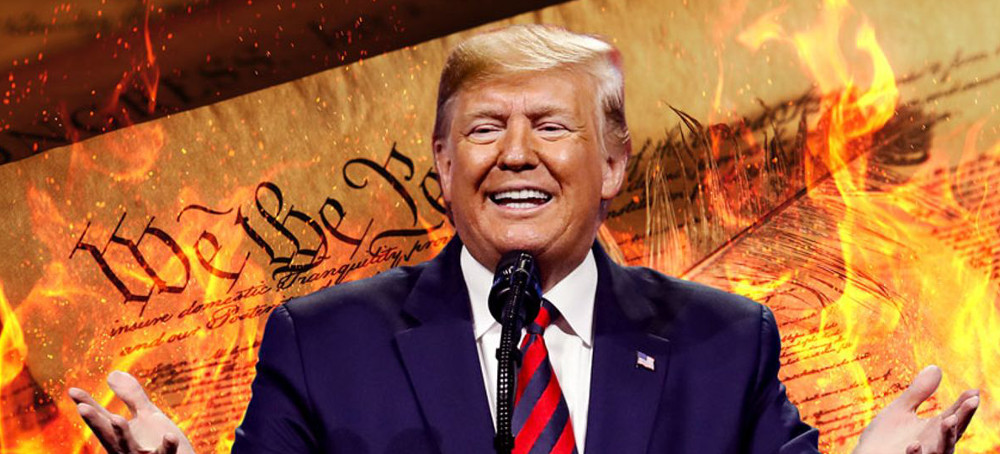
Former President Donald Trump promises to set our Constitution ablaze. (photo: Getty)


Is the center-left establishment too scared of Trump to stand up for the rule of law? That won't end well
Mike Lofgren / Salon

I worked as a congressional staff member during the protracted, nerve-wracking run-up to the Iraq invasion in 2003. Readers will recall a time of peak national hubris, with the White House, congressional Republicans and most of the press fairly bawling for war. It was then that I began to understand that Democrats were afraid of Republicans.

Given how pitifully weak the justifications were for an unprovoked invasion of a country that had nothing to do with 9/11, it was striking how many Democrats were swept along by it, more from conformity than conviction. Even those who opposed it usually advanced tepid, process-driven arguments. Sen. Robert Byrd of West Virginia, no one’s idea of a Squad progressive, was among the few Democrats who denounced the Iraq misadventure in hard-hitting and memorable terms. Why were Democrats pulling their punches?

I was reminded of that historic political timidity by the thesis of a center-left establishment warhorse, New York magazine's Jonathan Chait, that the U.S. government should not enforce the insurrection provision of the 14th Amendment to disqualify Donald Trump as a presidential candidate. Why not? Because Republicans won’t like it.

The author showcases excruciatingly nuanced logic-chopping over whether the violent takeover of the Capitol and attempted overthrow of government on Jan. 6, 2021, really was an insurrection according to his own ethereal definition; whether Trump actually honest-to-God incited it; and gee, what is insurrection, anyway — is it like secession, or different? Chait missed his calling as a medieval scholastic agonizing over how many angels can dance on the head of a pin.

He insists that those who support democracy and the rule of law face a terrible dilemma: How can we, the wise thinkers, possibly resist authoritarianism without seeming mean and unfair to all those reasonable Republicans we might otherwise win over to Team Democracy? Never mind that the number of them who would definitively abandon Trump is statistically negligible; the ones he cites (Mike Pence, Mitt Romney, Jeff Flake and Liz Cheney) have already abandoned electoral politics, and some of them have received death threats.

It is unnecessary to further deconstruct Chait’s bold counsel of passivity; Brian Beutler has already done an admirable job. What intrigued me, however, is that Beutler states, without saying precisely why he believes it, that Chait's argument is based in fear. I think he is correct, but his assertion needs expansion if we are to grasp the full implications of Chait’s thinking and those who agree with him.

Fear is certainly implicit in the cringing quality of Chait’s entire argument, and strongly suggested by his final paragraph: “It is going to be difficult to convince the American public that throwing a popular candidate off the ballot after it’s too late for his party to course-correct is the definition of democracy. Even if it were to succeed, it would bring the kind of short-term victory we might eventually come to regret.”

Why might we regret it? Why not spell out the reason? I suspect (although I can’t prove) that liberal pundits like Chait — who has a public reputation and a record of political advocacy — are consciously or subconsciously afraid of being identified and physically attacked by Trump supporters, or at a minimum afraid of massive violence in the country should Trump be disqualified. By virtue of being visible Trump opponents, they personally stand exposed to the “retribution” he has explicitly promised.

If Chait’s line of argument is fear-based, as Beutler believes, and if the underlying fear is that Trump’s followers could commit serious violence over disqualification, then why is there any reason to believe they wouldn’t behave in exactly the same way if Trump loses the election in 2024? Trump has already made it clear he won’t accept any result that does not mean victory for him.

And if Trump actually does win the election, why do people like Chait think that they personally, or society at large, will be safer than in a disqualification scenario? Suppose Trump declares martial law (as he has promised, although implausibly claiming it would only be “on day one”) and mass-deputizes tens of thousands of crazed gun nuts to exact the retribution he has offered his following.

The baleful precedent of Jan. 6 and the countless death threats to judges, politicians, election workers and others coming from Trump’s supporters suggest we should assume the possibility of a worst-case scenario. Given that the judge in Trump’s New York fraud trial, Arthur Engoron, received a bomb threat on the morning of the trial's final day, there is every reason to believe that violence is an ever-present danger for as long as Trump remains in elective politics. It’s one more reason, following Chait’s logic, to give in to Trump’s demands.

That said, let’s now assume another scenario, that the likelihood of violence is minimal. In that case, Chait’s thesis centers on his willingness to suspend enforcement of the Constitution as a kind of professional courtesy to Republicans who somehow failed to foresee the possibility of disqualification and didn’t plan an alternative.

Why do people like Chait appear to operate out of fear in the first place? Is it too hard to adhere to the plain text of the Constitution? Should the document be enforced only when those who face its sanctions agree? If enough of the punditry retreat alongside him, and there are plenty of influential examples, their fear could become self-fulfilling. The authoritarian psyche can sense fear and exploit it, a situation that suggests the far-right and center-left in this country are playing out yet another Stockholm syndrome.

Two decades ago, Jonathan Chait was one of those muscular New Republic liberals who was gung-ho on invading Iraq. When an action is popular, and when Republicans approve it (or stridently demand it, in the case of Iraq), Chait appears to be all-in for forceful solutions. Never mind that we were invading the wrong country.

But whenever politics demands heavy lifting, controversy and potential confrontation to defend the rule of law, not so much.

"Get me outta here!"  It's not just babies that are afraid of Trump.

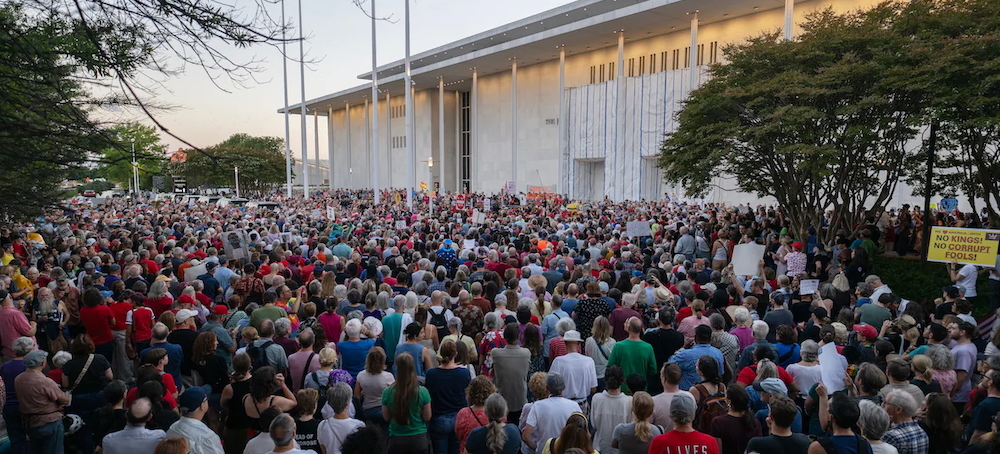
Thousands Rally Outside Shuttered Kennedy Center, Chanting ‘Hands Off!’

  Demonstrators gather outside of the Kennedy Center in protest of Trump's takeover and closure of the building. (photo: C...