Thursday, March 24, 2022

Will Republicans Pay Any Price for How They've Treated Judge Jackson?

'Republicans are trying to turn Judge Jackson's nomination into a cesspool of rabid partisan charges...'
 Will Republicans Pay Any Price for How They've Treated Judge Jackson? 

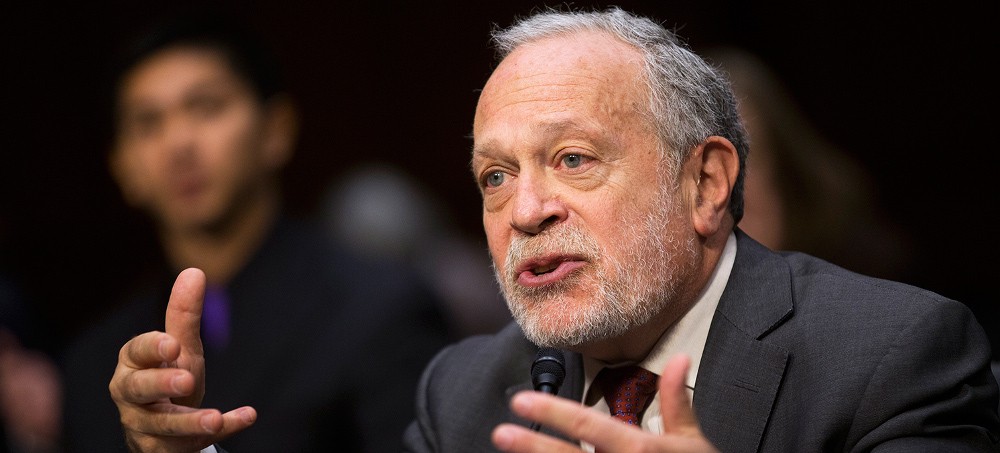
Robert Reich. (photo: Getty)

Why Josh Hawley, Ted Cruz and Lindsey Graham are below contempt!

Robert Reich / Robert Reich's Substack

readersupportednews.org 

Today, the Senate Judiciary Committee begins its third day of hearings on the nomination of federal appellate judge Ketanji Brown Jackson to the Supreme Court.

Lets’ be clear: Judge Jackson’s credentials are impeccable. She is the only Supreme Court nominee ever to have served as a public defender. She has handled civil and criminal cases, served on the federal sentencing commission, worked in private law firms and clerked for Stephen Breyer (the justice she’d be replacing). She has been a district court judge and a court of appeals judge. The American Bar Association has given her its highest rating. She is also the first Black woman nominated to serve on the high court.

But none of this has stopped senate Republicans from trying to turn her nomination into a cesspool of rabid partisan charges.

Yesterday, senators Lindsey Graham and John Cornyn claimed that Judge Jackson had called former defense secretary Donald H. Rumsfeld and former President George W. Bush “war criminals.” In fact, she never used that phrase. Ted Cruz insinuated she was soft on child sexual abuse. After displaying several large color photos from a children’s book called “Antiracist Baby” by Ibram X. Kendi, Cruz asked her “Do you agree with this book that is being taught with kids that babies are racist?”

But the cesspool prize goes to Senator Josh Hawley — the senator who, you recall, fist-bumped those who were attacking the U.S. Capitol on January 6 and voted against certifying Joe Biden as president. Hawley spent his entire 30 minutes questioning Jackson on a single case where he repeatedly referenced child pornography, sex trafficking, and pedophilia, after tweeting “Judge Jackson has opined there may be a type of ‘less-serious child pornography offender.’ … ’A ‘less-serious’ child porn offender?”

Utter rubbish. When she was vice chair of the U.S. Sentencing Commission, Judge Jackson once asked a question about child pornography during a hearing on sentencing guidelines in 2012. She said she was surprised at a Justice Department expert’s testimony that some child-sex offenders may actually “not be pedophiles” but perhaps “loners” looking for like-minded company in child pornography circles. She then asked the expert: “I’m wondering whether you could say that there is a — that there could be a — less-serious child pornography offender who is engaging in the type of conduct in the group experience level?”

Hawley’s charge was made for the most cynical of political purposes. America’s extreme right seems to have a fetish about pedophilia. Remember the 2016 “pizza-gate” — when Russian operatives, Trump campaigners, Twitter bots, and the radical right manufactured the ‘news’ that Hillary Clinton ran a pizza-restaurant child-sex ring? It turns out that nearly a quarter of Republicans say they believe that the U.S. government, media, and financial sector are controlled by a group of Satan-worshipping pedophiles who run a global child sex trafficking operation.) But for a senate Republican to distort an eminent jurist’s record like this is below contemptuous.

So we want this guy making Supreme Court decisions instead of Judge Jackson?  Because he's white?  And a man?  Give me the black lady any day.  Hands down.  No questions asked.  Case closed.

Wednesday, March 23, 2022

Senatorial Speeches at Beginning of Supreme Court Nomination Hearings Should Be Sh*tcanned

The Senatorial Speeches at the Beginning of Supreme Court Nomination Hearings Should Be Sh*tcanned   

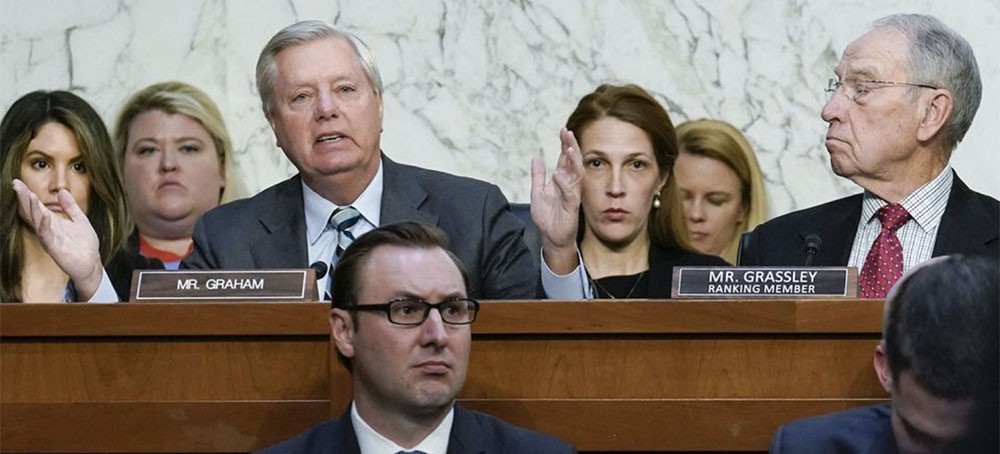
Senators Greasy Graham and Garulous Grassley. (photo: J. Scott Applewhite/Getty Images)

Submit the statements in writing and get on with it.

'If I were king of the forest, I would pass a rule for the Senate by which every opening statement by any senator in a confirmation hearing would be sent in writing to the committee chairman and entered into the record as written. That way, the first day of the hearings would consist of the nominee’s opening statement and then everybody could go home for the day. I came to this conclusion while watching the beginning session of the Senate Judiciary Committee hearing into the nomination of Judge Ketanji Brown Jackson to the Supreme Court. Herewith, my evaluation of the pros and cons of such a change.

Downside:

  1. No chance of hearing Senator Sheldon Whitehouse explain to his Republican colleagues that, if they want to bring some bullshit about “outside groups” and “dark money” supporting the nominee, he has several barges worth of receipts concerning the Federalist Society and its wingnut front groups conveniently moored along the Potomac.

  2. No chance to hear Senator Amy Klobuchar diss the Hapsburgs and silos, the latter a risky choice for a senator from Minnesota.

  3. No chance to hear Chuck Grassley wrestle with some absurd metaphor about elephants in mouseholes.

  4. No chance to see the nominee look at Tailgunner Ted Cruz in such a way as to become the living embodiment of the phrase, “Oh, please.”

Upside:

  1. Not having to listen to endless whinging about what happened to poor Brett Kavanaugh, and poor Robert Bork, and poor Janice Rogers Brown.

  2. Not having to listen to Young Ben Sasse give us a demonstration of When Middle School Civics Goes Horribly Wrong while throwing an elbow into the doctrine of unenumerated powers along the way.

  3. Not having to listen to Huckleberry Graham’s patented syrupy passive-aggression. I swear you could grease up an 18-wheeler with a paragraph of his rhetoric.

  4. Not having to listen to konztitooshunal skolar Mike Lee explain that, “The Constitution, written by wise men over 200 years ago. Wise men who I believe were raised up by almighty God for that very purpose.” And, in the Beyond, James Madison comes to the sad realization that his life’s work had no purpose.

  5. Not having to watch Tailgunner Ted Cruz mistake a Senate hearing room for an afternoon session at CPAC, thereby prompting the aforementioned look from the nominee.

  6. Not having to watch as the Reconstruction Amendments are simply read out of American constitutional history—“Cancelled,” if you will—in favor of a conservative concept of retroactive clairvoyance about what a bunch of 18th-century lawyers and slavers, and both, were thinking.

I’ll take the swap, actually. More to follow, I’m sure.

"And still," in the inimitable words of Moscow Mitch McConnell, "she persisted."

Tuesday, March 22, 2022

Abbreviated pundit roundup: Judge Ketanji Brown Jackson deserves to be on the Supreme Court

WASHINGTON, DC - APRIL 28: Ketanji Brown Jackson, nominee to be U.S. Circuit Judge for the District of Columbia Circuit, testifies during her Senate Judiciary Committee confirmation hearing in Dirksen Senate Office Building on April 28, 2021 in Washington, DC. The committee is holding the hearing on pending judicial nominations. (Photo by Tom Williams-Pool/Getty Images) 
If you liked RBG, you'll love KBJ.

We begin today’s roundup with analysis from John Cassidy at The New Yorker of yesterday’s opening hearing for the confirmation of Judge Ketanji Brown Jackson to the Supreme Court:

At the start of a weeklong hearing that was virtually sure to descend into performative politics and partisan acrimony, [Senator] Durbin stated clearly and briefly the two essentials of Jackson’s nomination: that it is a long-overdue event and that she appears to be eminently qualified. This outbreak of senatorial clarity and brevity, however, proved fleeting. After Durbin and the ranking Republican member, Senator Chuck Grassley, of Iowa, delivered their opening remarks, Jackson was obliged to sit for several hours and listen to the committee’s other twenty members deliver their own opening statements for the cameras, many of which were predictable. On the Democratic side, which is aching for a big political victory, some of them at least seemed heartfelt. “You, Judge, are opening a door that’s long been shut,” a beaming Senator Amy Klobuchar, of Minnesota, said. (She also hailed Jackson for dressing in a purple top, purple being the color of the Minnesota Vikings.) Senator Cory Booker, who himself broke a color line in becoming the first African American senator for New Jersey, was understandably emotional. “I feel this sense of overwhelming joy as I see you sitting there, as I see your family sitting behind you,” Booker said.

At The Atlantic, Yale law professor Linda Greenhouse takes a deep dive into the nominee's deep experience and the impact of her clerkship during a key era for the Supreme Court:

From a certain perspective, nothing is unique about Judge Jackson’s status as a former Supreme Court law clerk. A majority of the justices are former clerks, Breyer among them. But no two Supreme Court terms are alike. Each is shaped by the particular cases on the docket, by the tensions evoked as the justices work against the clock to resolve their disputes, by compromises reached or disagreements left to fester. Did her year at the Court shape the judge she later became? Inevitably it must have, in ways only she knows. And of course, she had an insider’s view of the events of her term that no outside observer shares. So the point of revisiting the 1999–2000 term is not to speculate or extrapolate but simply to describe the Court that she saw and experienced firsthand. Though today’s Court differs in obvious ways—the only justice besides Breyer still on the bench is Clarence Thomas—the backward look suggests that much about the current Court will be familiar to the former law clerk.

Here’s Eugene Robinson’s take at The Washington Post:

When I watch Judge Ketanji Brown Jackson sitting before senators at her Supreme Court confirmation hearing, I think of my mother. I think of my mother-in-law. I think of all the brilliant Black women in my life who had the talent and the qualifications — but not the opportunity — to reach the apex of American society. 

That they were denied the chance to use their gifts fully is the nation’s loss. Jackson’s achievements are a source of immense pride for anyone eager to see the country make the best use of all of its citizens. But the fact that it has taken until this late date for the first African American woman to be nominated to the high court is also a reminder of how racism and sexism have robbed us of greatness.

Meanwhile, at The Week, Joel Mathis says questions about expanding the court are a trap that should be ignored:

[T]he Supreme Court can't pack itself. It's widely understood by now that the number of seats on the court can be changed — the current number of nine has been in place since 1869 — but that can only be done by Congress and the president working together. It's a political question for the political branches to settle. The only reason to press Jackson on the issue is to draw her into a political battle that isn't in the purview of the job that she's seeking. It's a trap.

Some recent justices, including Breyer and the late Ruth Bader Ginsburg, have argued against packing the court, and that was their prerogative. Maybe Jackson will choose to weigh in sooner or later — and maybe she even has an opinion — but given how much Supreme Court nominees avoid expressing their views at confirmation hearings, there's no real reason she should feel required to do so.

Jennifer Rubin:

She is so manifestly qualified, so perfectly embodies the American dream and is so blessed with superior judicial temperament that it is obvious why Republicans are struggling. They just can’t seem to find a way to knock down a super-qualified, charming, humble and brilliant Black woman. It seems it does not occur to them that they should stop looking for the limelight (to further their presidential ambitions), ask short and reasonable questions and then vote to confirm on her qualifications. And that tells you everything you need to know about the decline of both the Senate and the Supreme Court.

On a final note, Shahrzad Shams at The Week details why reforms are needed to modernize the Court:

Today's supermajority conservative court has repeatedly overstepped its role as a neutral arbiter "calling balls and strikes" and has instead bent over backwards to protect corporate interests at the expense of the rest of us. Examples are rife — from Citizens United v. FEC, which has led to dark money dominating our political system, to Janus v. AFSCME, which has served a blow to public sector unions and collective bargaining efforts, to Michigan v. EPA, which has, in effect, placed industry profits on equal footing with protecting the environment.

These pro-corporate decisions were not made in a vacuum. Over the past two decades, the Roberts court has handed down a whole host of other decisions that have actively served to dismantle the legal architecture of racial and economic progress — by weakening the right to vote, stripping away worker protections, thwarting efforts to protect the environment, and restricting women's rights to bodily autonomy. Taken together, these decisions are a natural extension of the conservative movement's larger efforts to rig the economy for the few, at the expense of the many. In effect, the conservative majority has used the Supreme Court as a vehicle to carry out a broader, radical, far-right agenda.

If you liked RBG, you'll love KBJ.

Monday, March 21, 2022

Ukraine update: The incompetent dictator theory versus the hollowed-out army theory

 A man stands in front of a residential building damaged in yesterday's shelling in the city of Chernihiv on March 4, 2022. - Fourty-seven people died on March 3 when Russian forces hit residential areas, including schools and a high-rise apartment building, in the northern Ukrainian city of Chernihiv, officials said. (Photo by Dimitar DILKOFF / AFP) (Photo by DIMITAR DILKOFF/AFP via Getty Images)

Russia's military prowess mostly consists of shelling civilian-packed cities. It may because their army has been too hollowed-out to competently do much else.

A new Financial Times story gives a map-based, video-based summary of the Russian military campaign so far, including speculation on just why Russian forces appear to be doggedly continuing with the original plans for capturing major Ukrainian cities despite that campaign having already failed. Through most of Russian-held territory, Russian tactics have produced not just a territorial stalemate, but Russian equipment losses so severe that most current Russian efforts appear to be focused solely on shoring up what remains.

The Financial Times piece ponders, as we all are, why the Russian military has continued to carry out initial orders despite the seeming failure of the strategy—most famously represented, at this point, by Russia continuing to add vehicles to the already-gridlocked and endangered tens-of-kilometers-long convoy north of Kiev. One theory is that Russian autocrat Vladimir Putin is personally giving the orders, so his generals couldn't change strategies even if they wanted to; while it fits pleasantly with historic narratives of obsessed dictators running their own militaries into the ground in national attempts to create whatever imaginary victories Dear Leader has rattling around his own head, it is still not as likely as the other major hypothesis: an institutional failure.

It is not that the Russian military is stuck following the orders of a micromanaging incompetent, says that theory. It is that the Russian military is literally giving all it has to give, and cannot support alternative strategies. The logistical chains are not there. The replacement equipment is not there. The planes are not attacking timidly out of Russian caution, but because a good chunk of those planes are not airworthy to begin with—and because Russia has been unable to defeat Ukrainian air defenses.

We have little evidence for the micromanaging dictator theory, but we have great gobs of evidence hinting at the paper tiger theory. The seeming nonexistence of large-scale Russian tactical maneuvers has been baffling outside military analysts; abandoned Russian equipment speaks eloquently to the nation's inability to find fuel to send only a few kilometers across their own borders.

This does not absolve Putin, of course. It was his kleptocratic rule that prioritized corruption and sycophantic loyalty over competence and expertise, to the extent that the Russian military is subservient to that corruption rather than above it.

All parties expect the next phase of the war to look like past Russian campaigns. Rather than making tactical moves, the only effective Russian military attack strategy has been the use of artillery to level cities such that there are no more civilians there to resist—a strategy now being brought to bear in Mariupol. This is a strategy that best lets Russian military leaders ignore their military's inability to fight effectively in actual combat; while Russian troops take the defensive positions their battle groups are designed for, commanders can level civilian population centers from afar, achieving "victory" by erasing whatever they are supposed to be capturing while easing the burden of occupation by forcing the residents to flee as refugees.

But this is not and has never been a strategy. It has simply been the only path the Russian military has been able to use, in recent decades, to accomplish anything beyond minor tactical victories. It has long been noted as evidence of the Russian military's particular cruelty and predilection to war crimes, but we are seeing now that it may have become Russian doctrine solely because the corruption within the armed forces is so severe it has rendered the army incapable of doing anything else.

This tactic has not, however, been tried against a Russian foe that itself has enough military prowess to potentially dislodge those artillery positions. It has been used against cities whose military protection has been far slimmer than what Ukrainian defenders have offered up, and we do not know for absolute certain that even this rote Russian move will not itself collapse.

The supply lines to Kyiv are long, and Ukraine has its own artillery moving into position. Ukrainian air defenses are strong, and Russian planes are at great risk in each sortie. And Ukraine has shown considerable success in recent days in pushing back, and even potentially surrounding, Russian forward positions.

The Russian army appears to have one trick left—total devastation. But it relies not just on defending artillery positions, but defending the long, long supply lines bringing food and ammunition to the troops firing those weapons. Even Russian generals may be worried, at this point, about what happens to their war-crime trump cards north of Kyiv if Ukraine's defenders manage to recapture some of the ground behind them.

Who could have imagined that a ragtag Ukraine military would hold off the big, bad Russian bear.

Sunday, March 20, 2022

BERNIE SANDERS: We Are in the Midst of a Global Struggle With Nothing Less Than the Future of the Planet at Stake

We Are in the Midst of a Global Struggle With Nothing Less Than the Future of the Planet at Stake   

Senator Bernie Sanders (I-VT) greets reporters as he arrives for a vote at the U.S. Capitol in Washington, D.C. November 1, 2021. (photo: Jonathan Ernst/Reuters)

Bernie Sanders / Reader Supported News 
There must be no ambiguity in acknowledging that what the whole world is seeing from Vladimir Putin’s war in Ukraine is nothing less than a blatant violation of international law and human decency.

This war, in which a large powerful nation invades a smaller neighbor, has already killed thousands of innocent people, including many children. A large number of cities throughout the country are being leveled by long-range Russian missiles while others are under siege as people are running low on food, water and much-needed medical supplies. In the first week of the war alone, more than a million refugees crossed borders into neighboring countries. Some estimates now put the number of refugees at more than 3 million while many more have been displaced from their homes within Ukraine.

This has been a humanitarian disaster for the people of Ukraine, but it is much more than that. The Russian invasion threatens global energy and food supplies, is contributing to greater economic instability and the rising prices we see everywhere. And oh, by the way, this is all happening at a time when the world is already struggling with a global pandemic that has killed millions and the devastating impacts of climate change which threaten the very existence of the planet.

That is the bad news. And it cannot be sugar-coated. It is very bad.

But, in the midst of all this horror, there is some reason for optimism.

All across the world, people are waking up to the fact that there is a global struggle taking place between autocracy and democracy, between oligarchy and an economy that works for all, between authoritarianism and the right of people to freely express their views. There is also the beginnings of a new progressive global order that recognizes every person on this planet shares a common humanity and that all of us, no matter where we live or the language we speak, want our children to grow up healthy, have a good education, and live in peace.

We not only see this vision from people in the allied countries who are defending Ukraine and are speaking out against Putin's war, but from people within Russia as well.

It is extraordinary that in the autocracy that is Russia today, many thousands of incredibly courageous people have been out on the streets demanding an end to the war and speaking out against Vladimir Putin, knowing that it’s illegal to do so and that they will likely be arrested and punished. Putin recently referred to them as "traitors," a frightening term coming from a dictator.

Here in America, rising gas prices are waking people up to something we have long known, and that is that moving quickly to renewable energy is not just an environmental issue. It is a matter of national security.

Yes. Our reliance on fossil fuels will continue to mean more drought, more crop failures, scarcer drinking water, rising seas, extreme weather events, climate refugees, and more disease. In fact, climate change threatens the very wellbeing of the entire planet. But equally important, we must break our dependence on fossil fuel not only to save the planet, but to end the hold that billionaire dictators like Putin and the autocrats in the Middle East have over the entire global economy. This is a profound national security issue.

Sisters and brothers, we have long said that we are in the midst of a global struggle with nothing less than the future of the planet at stake.

Russia’s invasion of Ukraine has made that more clear than ever.

It is a global struggle between those who believe in democracy and the rule of law versus those who believe government exists to rob the people they purport to serve in order to make the billionaire rulers even richer.

It is a struggle between those who believe information should be open and accessible to all versus those who believe the flow of information should be controlled by the government and a small number of oligarchs.

It is a struggle between those who believe we should choose peace and international cooperation versus those who support xenophobia and massive amounts of military spending.

It is a struggle between a progressive movement that mobilizes behind a shared vision of prosperity, security and dignity for all people, against one that defends massive global income and wealth inequality.

And, in the midst of these difficult times, our job going forward is to build upon this global awakening and do everything we can to oppose all of the forces, whether unaccountable government power or unaccountable corporate power, who try to divide us up and set us against each other in order to advance their own power and financial gain.

We know that those forces have long worked together across borders.

We must do the same.

In solidarity,

Bernie Sanders

Don't mess with The Bern, Vladdy.  He's no Donald Trump.

Cartoon: It's the RePutincan Party


PUBLISHED TO

TWO brand new Tom the Dancing Bug books! Tom the Dancing Bug Awakens; and Tom the Dancing Bug, Without the Bad Ones! Order today, RIGHT HERE AND NOW.

"God bless Tom the Dancing Bug! Funny, succinct, and highly original, Ruben Bolling is able to make "Ruben Bolling's craft and commentary are as powerful and as pointed, as capable of making you laugh while breaking your heart as they were when we were all so very young." Neil Gaiman, from the Foreword to Tom the Dancing Bug: Into the Trumpverse

JOIN Tom the Dancing Bug's INNER HIVE. Join the team that makes Tom the Dancing Bug possible, and get exclusive access to comics before they are published anywhere, sneak peeks, insider scoops, extra comics, and lots of other stuff.  JOIN THE INNER HIVE TODAY.

PLUS you can sign up for the new free Tom the Dancing Bug Newsletter.

ALSO, PLUS you can follow @RubenBolling on the Twitters, and a Face Book, and perhaps some Insta-grams.

Saturday, March 19, 2022

PENNYFARTHING: D.C. 'freedom' truckers threaten to abuse 911 emergency system if Washingtonians don't stop flipping them off

GOLDEN VALLEY, ARIZONA - FEBRUARY 24: Supporters wave as participants in the ‘People’s Convoy’, supporters and truckers, drive in a convoy during a cross-country trip to protest COVID-19 mandates on February 24, 2022 in Golden Valley, Arizona. The protestors are calling for a full re-opening of the country and some truckers in the convoy are scheduled to arrive in Washington, DC, on March 5. (Photo by Mario Tama/Getty Images) 
Go truck yourselves.


‘They can be explosive’: Trump spews more BS about vaccines

    Ignorant President Donald Trump listens as White House deputy chief of staff Wicked Stephen Miller spews bile on Aug. 6.   AP He...