The Blue Country Gazette is the successor to the Rim Country Gazette, reflecting our evolution to a nationwide political blog for readers who identify as "blue," liberals, progressives, and/or Democrats. Our mission is to provide distinctive coverage of issues during a time of extreme polarization in the U.S. We strive to provide side-stories and back-stories that provide additional insights and perspectives conventional coverage often doesn't include.
In the Republican race to put forward the most repulsive agenda
possible, Sen. Rick Scott of Florida is definitely outpacing his GOP
counterparts.
Sure, Sen. Lindsey Graham of South Carolina sent his colleagues running when he introduced a national 15-week abortion ban and pledged that a GOP-controlled Congress would give it a vote.
But just as the dust was finally starting to settle again,
Scott, the Senate GOP campaign chief, boldly stepped into the void
Sunday to voice support for Graham's deeply unpopular trial balloon.
"Look, there’s arguments to do it at the federal level," Scott said on NBC News' Meet the Press
when he was asked whether abortion restrictions should be addressed on a
national level. "I’m pro-life, as you know. I think we ought to have
reasonable restrictions. I think a lot of people are comfortable with 15
weeks and exceptions for rape, incest and life of the mother, but every
candidate gets to make their choice."
Actually, nearly seven in ten registered voters
oppose the idea of a national abortion ban at base, and about
two-thirds of voters rejected Graham's 15-week ban without exceptions
for the health of the mother.
Then there's House Minority Leader Kevin McCarthy, who laid an egg last month
with his "Commitment to America." Voters were particularly turned off
by the plan's emphasis on rolling back cost-cutting measures that help
reduce the price of prescription drugs and protect people with
pre-existing conditions from getting gouged by insurance companies.
McCarthy clearly sought to soften the plan's language on banning abortion, saying only that Republicans would "protect the lives of unborn children and their mothers."
But Scott is really the total package, embracing a nationwide abortion ban on TV plus beating McCarthy to the punch by releasing his own heinous plan to "rescue America" back in February. It famously promises to raise taxes on 100 million working Americans and sunset Medicare and Social Security, among other things.
McCarthy didn't exactly have the guts to say Republicans want to slash Medicare, but that's clearly what the Republican Study Committee aims to do if the GOP retakes the House.
Bottom line, Rick Scott is the total package—telling voters
loud and proud that Republicans stand for raising taxes on working- and
middle-class Americans while simultaneously working to reduce the social
safety net they will depend upon as they age.
Senate Minority Leader Mitch McConnell has worked hard to keep the GOP agenda under wraps,
distancing his caucus from both Graham’s ban and Scott’s plan. But
McConnell no longer has any control over Senate Republicans, as
evidenced by his underlings freelancing without his permission. So
despite what McConnell says, he’s not running the show anymore.
And when Republicans tell us what they want to do, we should believe them.
With his power waning in the U.S. Senate, maybe it's time for Moscow Mitch to flee to Moscow where he is truly loved and revered.
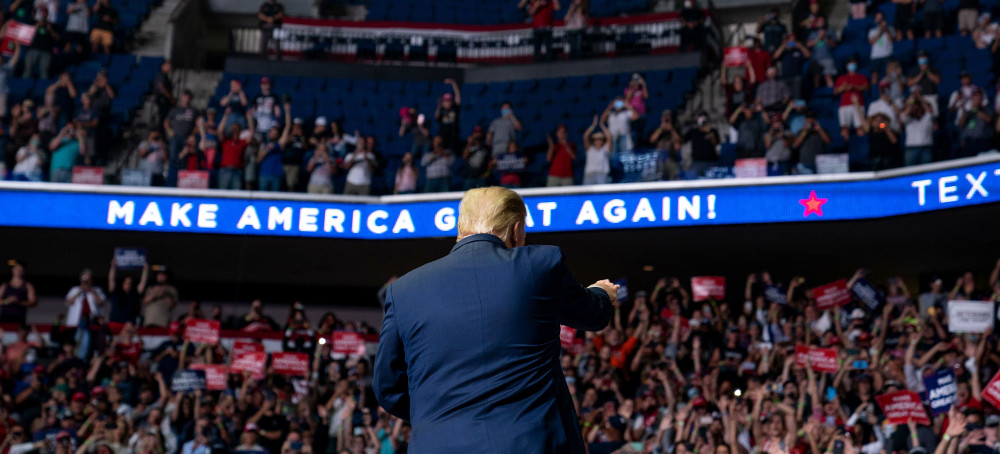
Donald Trump's rally in Tulsa, Oklahoma, in June 2020. (photo: Evan Vucci/AP)
06 October 22
"The Rhetoric is the candidate."
Dan Rather and Elliot Kirschner/Steady
United States intelligence agencies believe parts
of the Ukrainian government authorized the car bomb attack near Moscow
in August that killed Daria Dugina, the daughter of a prominent Russian
nationalist, an element of a covert campaign that U.S. officials fear
could widen the conflict.
The United States took no part in the attack,
either by providing intelligence or other assistance, officials said.
American officials also said they were not aware of the operation ahead
of time and would have opposed the killing had they been consulted.
Afterward, American officials admonished Ukrainian officials over the
assassination, they said.
The closely held assessment of Ukrainian complicity, which has not
been previously reported, was shared within the U.S. government last
week. Ukraine denied involvement in the killing immediately after the
attack, and senior officials repeated those denials when asked about the
American intelligence assessment.
The spinelessness of Republican officials should not excuse the fact
that Trump is once again wading into very dangerous waters, especially
when you consider the fervor (and the arsenals) of many of his
supporters. Although “wading” is not the most accurate verb for his
behavior. Trump is not a mere passerby, and he is never tentative. He is
an expert at roiling, stoking, and destroying the equilibriums of our
democracy with his incendiary rhetoric.
This latest episode had me thinking back a few years to another
moment that eerily forbode the present. This was well before the violent
insurrection of January 6, before Trump told the Proud Boys to “stand
back and stand by,” even before “very fine people on both sides.”
The date was August 9, 2016, and Trump was leading a campaign rally
in Wilmington, North Carolina. He had the crowd in a frenzy with his
usual attack lines against Hillary Clinton. And then he went somewhere
so outrageous that it sent out shockwaves — which is notable considering
that by this point, much of his daily bile had already been normalized.
“If she gets to pick her judges, nothing you can do, folks,” he said.
The crowd booed. Trump, sensing a moment, then added, “Although the
Second Amendment people — maybe there is, I don’t know.”
The insinuation was clear, and it is worth remembering what it
exposed at that moment, before Trump ascended to the presidency and
everything else that followed. So I thought it might be of interest to
reshare what I posted on Facebook in the hours after that statement.
Sometimes it is important to look back and remember what was said at the
time.
No journalist trying to be objective and fair, no citizen
who cares about the country and its future can ignore what Donald Trump
said today. When he suggested that "The Second Amendment people" can
stop Hillary Clinton, he crossed a line with dangerous potential. By any
objective analysis, this is a new low and unprecedented in the history
of American presidential politics. This is no longer about policy,
civility, decency, or even temperament. This is a direct threat of
violence against a political rival. It is not just against the norms of
American politics, but it raises a serious question of whether it is
against the law. If any other citizen had said this about a presidential
candidate, would the Secret Service be investigating?
Candidate
Trump will undoubtedly issue an explanation; some of his surrogates are
already engaged in trying to gloss over it, but once the words are out
there, they cannot be taken back. That is what inciting violence means.
To
anyone who still pretends this is a normal election of Republican
against Democrat, history is watching. And I suspect its verdict will be
harsh. Many have tried to do a side-shuffle and issue statements saying
they strongly disagree with his rhetoric but still support the
candidate. That is becoming woefully insufficient. The rhetoric is the
candidate.
This cannot be treated as just another outrageous
moment in the campaign. We will see whether major newscasts explain how
grave and unprecedented this is and whether the headlines in tomorrow's
newspapers do it justice. We will soon know whether anyone who has
publicly supported Trump explains how they can continue to do so.
We
are a democratic republic governed by the rule of law. We are an
honest, fair, and decent people. In trying to come to terms with today's
discouraging development, the best I can do is to summon our greatest
political poet, Abraham Lincoln, for perspective:
"We are not
enemies, but friends. We must not be enemies. Though passion may have
strained, it must not break our bonds of affection. The mystic chords of
memory, stretching from every battlefield, and patriot grave, to every
living heart and hearthstone, all over this broad land, will yet swell
the chorus of the Union, when again touched, as surely they will be, by
the better angels of our nature."
Lincoln used these stirring
words to end his First Inaugural Address. It was the eve of the Civil
War, and sadly his call for sanity, cohesion, and peace was met with
horrific violence that almost left our precious Union asunder. We
cannot, must not let that happen again.
What the Trump presidency would become was apparent long before the
election. All the instances like the one above that should have
immediately disqualified him from that office were ultimately folded
into permissiveness by far too many people. We should strive to always
remember and never become inured to this.
Before Trump, it was unfathomable that a presidential candidate would
speak and act with even a fraction of his recklessness and divisive
appeal to anger and violence. But now, sadly, we are long past having
the ability to imagine this atrociousness. We can see the corrosive
effects he and his enablers have wrought on this country.
Threats of violence must be condemned, in no small part because threats can become real. Just look at January 6.
For the past week, headline news has focused
almost exclusively on the scenes of desperation and destruction left in
the wake of Hurricane Ian. So most of us missed taking note of last
Friday's investiture
of Justice Ketanji Brown Jackson, the first Black woman on the Supreme
Court. She was sworn in last June so this was a formality, but it still
carried the weight of history and the court was filled with political
and judicial luminaries, including President Biden and Vice President
Harris. It was by all accounts
a moving ceremony. But considering all the turbulence on the Supreme
Court right now, I have to wonder if Jackson might be having second
thoughts.
Today is the first Monday in October, the first day of the new
Supreme Court term — and the court is in crisis. According to the Gallup
poll, its public approval ratings have never been lower, with 58% of Americans disapproving
of how this court is handling its job. A good part of that can be
attributed to the Dobbs decision overturning the right to abortion,
which had been effectively enshrined in the Constitution for 50 years.
That it came fast on the heels of two underhanded end-runs by the
Republican-controlled Senate — blocking the nomination of Merrick
Garland in 2016, and then jamming through Amy Coney Barrett in 2020 —
made it all the more rank. The court's right-wing majority couldn't even
wait another year or two, just for appearance's sake.
Dobbs wasn't the only case last term that exposed what partisan hacks the court majority have become. They also ruled that
despite centuries of jurisprudence allowing the regulations of
firearms, a New York state law requiring concealed carry licenses, on
the books for more than 120 years, was somehow a violation of the
Second and 14th amendments. In his majority opinion, Justice Clarence
Thomas made it very clear that he didn't hold with his former colleague
Antonin Scalia's view that the Second Amendment is not absolute when it comes to private ownership of guns.
And in case anyone thought the court might think twice about gutting
the EPA in light of the planetary climate upheaval we now see unfolding
every day, they did not. In another 6-3 opinion,
justices denied the EPA the right to demand emissions caps as part of
the Clean Power Plan, siding once again with red-state climate-change
deniers and Big Energy interests.
All those opinions came virtually on top of each other at the end of
the court's spring term, and its approval rating sank precipitously
right after that. But the more recent nosedive in public opinion is
likely also connected to the fact that one prominent justice is married
to someone who was heavily involved in the post-election Big Lie
campaign, and perhaps with illegal attempts to overturn the election.
Ginni Thomas, the wife of Justice Clarence Thomas, was interviewed last
week by the House Jan. 6 committee, and reportedly said that she still
believes the 2020 election was stolen. That all might be considered a
case of very poor judgment by the spouse of a Supreme Court justice, if
it weren't for the fact that Thomas has refused to recuse himself from
any cases pertaining to Donald Trump — and has consistently supported
Trump in pretty much every instance. Furthermore, the public has
gradually become aware that Thomas and the other justices aren't
required to adhere to any clear ethics rules or standards — because
there aren't any.
Chief Justice John Roberts and Justice Elena Kagan — the latter is
among the three remaining "liberals" — have been obliquely arguing with
each other about the court's loss of prestige and legitimacy in various
speeches they've given over the last few weeks. Roberts, a smart guy
deliberately playing dumb, has wondered aloud why people might thing the
court has become purely political just because they disagree with the
outcome of certain cases. Kagan, meanwhile, has patiently pointed out
that when the court starts overturning precedents one after the other
after a dramatic shift in personnel, it might make people just a little
suspicious that politics is at work. Here's how Slate justice reporter
and analyst Dahlia Lithwick put it:
[I]t is not that the public didn't like the final score at
the end of the term when the lights went out in June. The problem wasn't
just the losses; the problem was that [Roberts'] team moved the game to
another field, then stole the ball and replaced it with a time bomb,
then changed the rules, then lied about it, and then set the entire
field ablaze. Now he wants everyone to shake hands and go home.
Unfortunately, they aren't finished. Indeed, the right-wing justices
and their allies are just getting started. If this term goes like the
last one, get ready for the court to lose another 20 points in approval.
It will hear cases on religion, free speech, LGBTQ rights, affirmative
action and voting. It's not hard to imagine where the right-wing
majority that signed on to the Dobbs decision will go now that they've
decided to let it all hang out.
The legal precedents on affirmative action were thought to be so firmly established, according to New York Times, that the late Justice Ruth Bader Ginsburg assumed the issue had been permanently settled. Apparently not. The court plans to hear two cases that could once again upend precedents in place for half a century. Then there's Merrill v. Milligan, which is poised to destroy what's left of the Voting Rights Act, and Sackett v. EPA,
which is likely to further degrade the federal government's ability to
enforce clean water standards, meaning that what happened to the water
systems of Flint, Michigan, and Jackson, Mississippi, could happen in
your town as well. In the latest bogus "religious freedom" case, 303
Creative v. Elenis, the court may enshrine the right to discriminate
against LGBTQ people on religious grounds.
Then we get to perhaps the most chilling case of all, Moore v. Harper, which aims to establish the "independent state legislature" theory
as the law of the land, essentially giving any Republican legislative
majority in a swing state the power to do whatever it chooses when it
comes to elections — with no checks on its power, including from state
courts, the governor or any other election officials. Let's put it this
way: If this had been in effect in states like Arizona, Michigan and
Pennsylvania in 2020, it's entirely possible that right-wing state
legislators could have done exactly what folks like Ginni Thomas wanted
them to do — refuse to count certain votes, or even appoint their own
slates of presidential electors in defiance of the voters. And you don't
even want to think about what how creative they could get with
gerrymandering districts so Republicans never lose.
So get ready. The Supremes are on a roll and it doesn't look like
they have any plans to "moderate" in light of the fact that the public
now perceives them as nothing more than an enforcement arm of the
Republican Party. Public opinion, in this case, isn't wrong. Old-time
conservative movement ideology may be widely unpopular these days, is
firmly entrenched in the high court and they are making all their dreams
come true. Who's going to stop them?
"You don't
even want to think about how creative [the Supremes] could get with
gerrymandering districts so Republicans never lose."
Abortion
rights activists yell during a protest in the wake of the decision
overturning Roe v. Wade outside the U.S. Supreme Court Building on June
25, 2022 in Washington, D.C.
Two Civiqs tracking polls suggest that Republicans and Donald
Trump are in a newly precarious position with both independent women and
men, but likely for different reasons.
Civiqs' generic ballot tracking poll shows Democrats ticking up
to 49%, their highest point since tracking began over a year ago and a
4-point edge over Republicans.
Democrats began to break away from Republicans in mid- to late-July, about a month after the Supreme Court decision overturning Roe v. Wade
and upending a half century of settled reproductive rights law. But the
demographic that clearly fueled the recent Democratic bump in Civiqs
polling was independent women.
When the Supreme Court decision dropped in late June, the two
parties were roughly tied with independent women at around 39%. But
around mid-August, Democrats started gaining traction with the cohort,
leading to their current 8-point advantage, 47% - 39%.
But women aren't the only independents who appear to be waking up to
the threat Republicans pose to the country. Independent men are souring
on Donald Trump himself, according to Civiqs tracking of his favorables.
What caught our eye was the fact that Trump, sitting at a 38%
favorable rating, dropped below 40% in the tracking poll for the first
time since he won the 2016 election.
Digging deeper, that falloff is driven mainly by independent
men, with whom Trump is currently 13 points underwater, 39% - 52%. The
turnaround came quick. In early August, Trump's favorables/unfavorables
among the cohort was roughly even at 45% - 46%. Then the FBI searches
Mar-a-Lago on Aug. 8 and news breaks that Trump stole highly sensitive
documents (some related to nuclear secrets). It's all downhill from
there. In fact, Trump’s even taken a 2-point hit among GOP men, from 83%
to 81%.
One of the more virtuous qualities of Civiqs tracking polls is that
they don’t bounce around all the time. Trump’s favorables are a perfect
example—he spent nearly six years hovering somewhere between 41%
— 44% favorability. So when Civiqs does show a change—a notable drop in
this case—something is usually up.
Whether the disenchantment of independent men with Trump will
translate to November election results is an open question. But given
that Trump’s paws are all over this election and he is now a staple in
national headlines, his omnipresence likely isn’t helping Republicans
among a key demographic that often leans Republican.
More than a decade ago, Ginni Thomas’s political activities drew scrutiny to her more public husband. More to the point, the failure
of that husband, Supreme Court Justice Clarence Thomas, to
declare decades of his wife’s income from that political activity drew
attention, resulting in him revising 20 years’ worth of financial
disclosure forms. That included $686,589 she earned between 2003 and
2007 from the conservative Heritage Foundation think tank.
It also included her work at Liberty Central, a conservative
“political education” group she co-founded in January 2009. It ceased
operations in 2012. The timing of the organization’s existence is
critical, because its primary mission seemed to be opposing President
Barack Obama’s Affordable Care Act. Ginni Thomas wrote an article
for the organization’s website in 2010 declaring that the new law was
unconstitutional. Guess how hubby Clarence voted on that in the Supreme
Court? That was in 2012, when one tenuous vote from Chief Justice John
Roberts saved the ACA, and when Liberty Central disbanded.
Fast forward 10 years and the Supreme Court code of ethics,
transparency, and disclosure that good government groups have been
clamoring for has yet to be enacted, and Clarence and Ginni Thomas are
in the news again because she helped try to overthrow the government.
Thomas reportedly
told the House select committee investigating the Jan. 6 insurrection
that “she has ‘never’ spoken to her husband about pending cases before
the Supreme Court, calling it an ‘iron clad rule in our home.’” Maybe
she also never told him about all the money she was earning from
conservative groups thanks to her proximity to a Supreme Court justice.
The Thomases are the most enduringly egregious examples of why there
needs to be not just an expansion of the Supreme Court, but real reforms
that include finally making the court comply with a code of ethics—just
like every other branch of the judiciary is compelled to do. But the
Thomases are definitely not the only Supreme culprits in fishy spousal
entanglements.
Meet Jesse M. Barrett and Jane Roberts, spouses to Justice Amy Coney Barrett and Chief Justice John Roberts, and subject to a deep investigative dive by Politico
Jesse Barrett’s law firm, SouthBank Legal,
just happened to expand from its South Bend, Indiana, base to
Washington, D.C., a year after his wife reached the Supreme Court. His
specialties are “white-collar criminal defense, internal investigations,
and complex commercial litigation.” His firm of fewer than 20 lawyers
has clients in “virtually every industry,” including “over 25 Fortune
500 companies and over 15 in the Fortune 100.” Chances are pretty darned
good that at some point, a case involving one of those companies has
come before the Supreme Court.
But we don’t know, because Barrett doesn’t have to disclose any of
her husband’s clients in her disclosure documents, much less recuse
herself in any of those cases. Politico reports that in her most recent
disclosure, she redacted the name of her husband’s firm. On his law firm bio
Barrett says he has “tried several dozen federal cases to jury verdict
and has handled numerous appeals, including successful arguments in
state and federal appellate courts.” So his own work, and his firm’s,
could definitely come before the Supreme Court. But in those appellate
courts, every judge is going to know who is arguing in front of them: a
Supreme Court justice’s husband, just one wrinkle in the complicated
judicial ethics/spousal debate.
In 2007, Jane Roberts quit her job as a partner at Pillsbury Winthrop
Shaw Pittman to become a legal recruiter—a headhunter for law firms.
John Roberts became chief justice in 2005. The other Roberts in now
managing partner at the Washington, D.C., office of Macrae, a firm which
exists for the purpose of placing high-powered attorneys with
high-powered firms. “Macrae knows law firms,” their website boasts. “Their
practices. Their geographic markets. Their cultures. Our passion built
an inclusive transatlantic network to identify optimal affinities.”
It’s a lucrative business. Politico reports that “A single placement
of a superstar lawyer can yield $500,000 or more for the firm.” A
superstar lawyer and a high-powered law firm can only be helped by
having that connection made by someone in such proximity to real power.
The guy who hired Jane Roberts for her previous job admitted it freely,
telling Politico that they wanted the benefits of having the wife of the
chief on their staff because “her network is his network and vice
versa.”
Robert does list the name of her company on his disclosures, but not
the lawyers and the firms she’s worked with, “even though her clients
include firms that have done Supreme Court work, according to multiple
people with knowledge of the arrangements with those firms,” Politico
found in its investigation of Supreme spouses and ethical conflicts.
Politico contacted both Barrett’s and Roberts’ firms, and heard back
from a Supreme Court spokesperson in the case of Barrett: “Justice
Barrett complies with the Ethics in Government Act in filing financial
disclosure reports.” Which is the crux of the problem: She’s complying
with the Swiss cheese of judicial ethics requirements, and taking full
advantage of all the holes.
Pushed further on the broader question of disclosures by justices of their spouses work, the spokesperson pointed to a statement the court issued in 1993, rejecting the idea that there could be any kind of conflict of interest for a justice in a spouse’s work.
“We do not think it would serve the public interest to go beyond the
requirements of the statute, and to recuse ourselves, out of an excess
of caution, whenever a relative is a partner in the firm before us or
acted as a lawyer at an earlier stage,” the seven justices who adopted
the policy declared. “Even one unnecessary recusal impairs the
functioning of the court.”
That was back when 80% of the population had
at least some confidence in the Supreme Court, and 47% had a great
deal/quite a lot of confidence in it. Now 68% express some degree of
confidence, but just 25% say a great deal or quite a lot, and 30% of
people now have very little confidence in it. That might be because the
modern Supreme Court has done little to show that it’s anything but a
partisan political entity intent on imposing its out-of-the-mainstream
will on the American people.
The arrogance the court showed in 1993 is still on display today.
Earlier this year, Barrett participated in an interview with Fred Ryan,
former Politico chief executive officer and current publisher of The Washington Post.
He asked about the potential for conflict with her husband’s work, and
Barrett said that it wasn’t the court that had to change, but public
expectations.
“But you know, I think we’re living in a time when we have a lot of
couples who are both, are working, and so I think that the court and,
you know, society has to adjust to expect that,” Barrett said. Asked
about whether the court should adopt some guidelines to address the
problem of spousal conflicts, she blew the question off. “I don’t think
most of the spouses would be very happy about those guidelines,” she
answered. “Certainly when I try to give my husband guidelines about what
to do and not to do in the house even that doesn’t go over very well.”
That kind of arrogance and untouchability makes trusting the justices
to do the right thing difficult. As does the work of the people they
share their personal lives—and finances—with. Sen. Sheldon Whitehouse
(D-RI) puts it succinctly: “The ethical rot at the court continues to
spread, and public faith in the court erodes along with it.”
“The questions about financial conflicts of interest are one area of
concern among many. There’s also the flood of dark-money influence
bearing down on the court, from the nameless donors behind judicial
selection to the orchestrated flotillas of anonymous amici curiae
lobbying the justices to the spate of partisan decisions handing wins to
corporations and big donor interests,” Whitehouse said.
After the last term of absolutely trash decisions out of the court
(with the next term promising more of the same), the other two branches
of government need to get serious about fixing it. That means imposing a
code of ethics and expanding the court.
And speaking of rot, let's not forget the "I like beer" guy. Aren't you comforted knowing that this dude is on the court helping to decide what you can't do with your own body and in the privacy of your own bedroom?
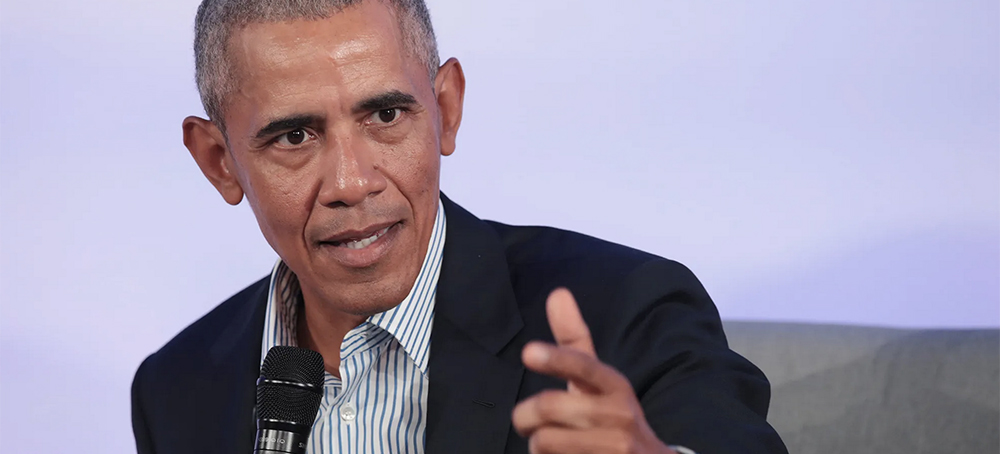
As we’ve previously noted
around these parts, the biggest criticism of Barack Obama between the
years of 2016 and 2020 related to his decision not to voice the opinions
you know he absolutely had about Donald Trump. Indeed, it was not even until the end of 2018 that the 44th president uttered his successor’s name in public, despite the fact that most of the world was regularly referring to him with terms like “certified moron,” “an idiot surrounded by clowns,” “Adolf Twitler,” and, we assume, “a malignant tumor on the colon of society.”
While Obama did choose to start talking toward the end of 2020—warning that August that Trump would “tear our democracy down” if given the chance—the remarks that he reportedly
made in private were the ones people probably would have appreciated
hearing the most, wherein he described the 45th president as “a madman,”
“a racist, sexist pig,” a “corrupt motherfucker,” and a “fucking
lunatic.” And apparently, he had other things to say about the guy too.
Bloomberg News reports
that in his final days as president, Obama warned reporters, in an
off-the-record conversation, that while America would be “okay” from
four years of Trump, “eight years would be a problem. I would be
concerned about a sustained period in which some of these norms have
broken down and started to corrode.” (The remarks were revealed in a
transcript that was released in response to a Freedom of Information Act request filed in 2017 by reporter Jason Leopold.)
Trump has, of course, been threatening to make another bid for office
for some time now, which, if successful, would give him those eight
years Obama warned against. While that would obviously be extremely bad
for humanity, one might argue that the country is already quite worse
for wear after just the first four, and that Obama was a little too
optimistic about how Trump’s first term would shake out.
Elsewhere in the conversation, Obama told reporters that he didn’t
believe Trump was keen on starting any wars, though he would probably be
into “bombing the heck out of terrorists.” (In early January 2020, the
Trump administration assassinated Iranian military leader Qasem Soleimani; Trump would later complain
that he didn’t get enough credit for this, and that he should have
because Soleimani was a much “bigger” terrorist than Osama bin Laden,
whose 9/11 attacks he bizarrely attempted to downplay.) “I think his
basic view—his formative view of foreign policy is shaped by his
interactions with Malaysian developers and Saudi princes, and I think
his view is, ‘I’m going to go around the world making deals and maybe
suing people,’” Obama said during the chat. “But it’s not, ‘let me
launch big wars that tie me up.’ And that’s not what his base is looking
[for] from him anyway.”
According
to Bloomberg, Obama said his biggest
fear about his successor was the politicization of the nation’s top law
enforcement agency. “I would be like white on rice on the Justice
Department,” Obama told reporters. “I’d be paying a lot of attention to
that. And if there is even a hint of politically motivated
investigations, prosecutions, et cetera, I think you guys have to really
be on top of that.” Trump, of course, spent much of his time in office
demanding the DOJ investigate his political rivals, including Obama, Joe
Biden, and Hillary Clinton. As Bloomberg notes, “Geoffrey Berman,
the former US attorney for the Southern District of New York, recently
accused Trump’s Justice Department of meddling in prosecutions and
pressuring his office to launch politically motivated probes into
Trump’s adversaries.”
In addition to opining on Trump, Obama reportedly offered his
thoughts on the GOP, saying that “the Republican Party now is
ideologically completely incoherent. You don’t know what they stand for.
So what’s bound them together is opposition to me, opposition to a
fantastical creature called the liberal who looks down on them and just
feeds all that regional resentment. And there are a handful of issues,
like guns, that trigger that sense of ‘these folks aren’t like us and
they don’t like us and act like us.’ And there’s obviously some racial
elements that get put out into that stew.”
Ginni Thomas swears she never once discussed her attempt to
overturn the 2020 election with her husband, Supreme Court justice
Clarence Thomas
And if you believe that, we’ve got a bridge to sell you. Per The New York Times:
During her interview, Ms. Thomas, who goes by Ginni, repeated her
assertion that the 2020 election was stolen from President Donald J.
Trump, [Rep. Bennie] Thompson said, a belief she insisted upon in
late 2020 as she pressured state legislators and the White House chief
of staff to do more to try to invalidate the results. In a statement she
read at the beginning of her testimony, Ms. Thomas denied having
discussed her postelection activities with her husband.
In her statement, a copy of which was obtained by The New York Times,
Ms. Thomas called it “an ironclad rule” that she and Justice Thomas
never speak about cases pending before the Supreme Court. “It is
laughable for anyone who knows my husband to think I could influence his
jurisprudence—the man is independent and stubborn, with strong
character traits of independence and integrity,” she added.
In March, shortly before Thomas’s incredibly damning text messages with Mark Meadows regarding the 2020 election were revealed, she admitted
in an interview that she’d attended the “Stop the Steal” rally that
preceded the January 6 attack on the Capitol, adding, of her husband,
“Like so many married couples, we share many of the same ideals,
principles, and aspirations for America.” But she also insisted: “We
have our own separate careers, and our own ideas and opinions too.
Clarence doesn’t discuss his work with me, and I don’t involve him in my
work.” Which was about as believable then as it is now.
Roughly three months before Florida was clobbered by this week’s climate-intensified hurricane,
eight of the state’s Republican lawmakers pressured federal regulators
to halt a proposal requiring businesses to more thoroughly disclose the
risks they face from climate change. Those lawmakers have raked in more
than $1 million of campaign cash from oil and gas industry donors,
according to data reviewed by the Lever.
The proposed rules from the Securities and Exchange Commission (SEC)
are designed to give investors, government officials, and the general
public much more information and details about the dangers of climate
change. But even in Florida — one of America’s most climate-threatened states — top Republicans are trying to help fossil fuel industry lobbyists
block such disclosure mandates that could better inform communities
about climate risks. Those mandates could also help identify which
carbon-emitting companies are most responsible for the climate crisis.
On June 15, seven of Florida’s House lawmakers signed a letter
to SEC chair Gary Gensler demanding he rescind a proposal that would
require large corporations to “disclose extensive climate-related data
and additional ‘climate risks.’”
“Congress did not establish the SEC to set climate policy nor to be
the final arbiter of businesses’ strategies to combat climate change,
which is what these rules will do,” the lawmakers wrote, lambasting the
agency for “taking a novel, activist approach to climate policy.”
The following Florida Republican House members signed the letter
while pulling in fossil fuel industry campaign cash: Gus Bilirakis ($259,550), Vern Buchanan ($174,490), Kat Cammack ($54,737), Byron Donalds ($60,163), Neal Dunn ($20,902), Bill Posey ($127,000), and Mike Waltz ($71,553).
In a separate letter signed by Florida Republican senator Rick Scott — who has received more than $236,000
from fossil fuel industry donors — thirty-two GOP senators slammed the
agency for “mandating climate change reporting requirements that will
not only regulate publicly traded companies, but will impact every
company in the value chain.”
After the letters, Gensler signaled that his agency could pare back the disclosure rules.
The effort to kill climate risk disclosure rules has long been led by
Posey, who represents a district on the central Atlantic coast of the
state. In 2011,
Posey authored legislation to statutorily bar the agency from requiring
corporations to tell investors about the ways climate change affects
their business.
“Instead of enforcing climate change policies, the SEC might want to
focus its attention on protecting investors from fraud and abuse in the
financial markets,” Posey said at the time.
Florida GOP Politicians Still Behaving Like Climate Denialists
Climatescientists
say storms like Hurricane Ian that has battered Florida are
intensifying more quickly because climate change is warming ocean
waters. There appears to be some broader recognition of the link in the
state: Between 2019 and 2021, the number of Florida Republicans who
believe climate change is real doubled from 44 percent to 88 percent,
according to surveys by Florida Atlantic University.
However, many of Florida’s Republican politicians have not reflected that shift.
In Washington, every Republican member of Florida’s congressional delegation votedagainst
an infrastructure bill providing billions of dollars in investments in
climate-related weatherization and flood mitigation. Florida Republican
governor Ron DeSantis derided the $19 billion earmarked for the state.
Meanwhile, last month
DeSantis spearheaded an initiative to bar his state from considering
environmental factors such as climate risks in its investment of
billions of dollars of retirement savings of teachers, firefighters, and
other government workers.
DeSantis, who is running for reelection, has vacuumed in more than $800,000
of campaign cash from oil and gas industry donors, according to data
compiled by the National Institute on Money in State Politics. That
includes more than $314,000 directly from the coffers of fossil fuel companies.
Mar-a-Lago escapted disaster this time, but Republicans are sure to give other hurricanes at shot creating this scene.