Tuesday, July 6, 2021

The Supreme Court's Conservatives Have Laid the Groundwork for the Devastation to Come

Justice Brett Kavanaugh and Chief Justice John Roberts. (photo: Getty Images)
Justice Brett Kavanaugh (posing here as a choirboy) and Chief Justice John Roberts. (photo: Getty Images).  See photo at end of story for another side of Boy-Brett.

By Dahlia Lithwick and Mark Joseph Stern, Slate

06 July 21

readersupportednews.org

n many ways the 2020 term at the Supreme Court followed the progression of the coronavirus. There were different phases and stages, distinct strains and variants; there was death and grief and new life and rebirth. And through it all there was gaslighting and denial. Until about a week ago, we heard a lot of media stories of a confounding and unpredictable court, with improbable lineups and unlikely bedfellows. And sure, there has been a lot of that. But Thursday saw a change in narrative with the thunking down of two cases that seemed to poke at the very fabric of democracy; a one-two punch that took aim at Section 2 of the Voting Rights Act and the ability to challenge election laws that burden racial minorities, and seemingly opened the floodgate to unaccountable and untraceable dark money flooding into a system that is already drowning in it. It almost defies comprehension that a Supreme Court that devoted so much energy, all year long, to appearing removed from partisan politics, chose the very last day of the term to let us know that when the rubber hits the road, partisan politics is what matters.

It’s hard to find a metric to measure which story holds up. Was it a 3-3-3 court? Was it a 4-4-1 court? Was it a 2-2-1-2-3 court? Only Count von Count might be able to say. Each of those tales was true, and also not true. There were only 58 merits cases from which to judge. Some of the seeming blockbusters fizzled: The Affordable Care Act challenge not only failed but got kicked to the curb. It turns out enough time has passed to make ACA challenges passé, and also that throwing people off their health care plans in a pandemic was too Dickensian for even this court. The swearing cheerleader got a lot of media attention, because who doesn’t like Cocoa Hut, middle fingers, and varsity cheer? But the case stands for the enduring First Amendment proposition that student speech off campus is to be tolerated, unless it is not. The same basic rule emerged from Fulton v. Philadelphia—what should have been the most important religious liberty case of the year was decided unanimously and seems to stand for the landmark principle that if there is any discretion within your foster care certification policy, it isn’t a generally applicable policy, but who knows what all else. As we have been writing in this space for years now, the court is phenomenally good at using the distinction between the warp speed of political time and the slow burn of judicial time to make big things seem inconsequential and tiny things seem vital.

The statistical measures of winning and losing justices will only get you so far. It’s true that the liberal justices were in the majority a lot. It’s true that Justices Brett Kavanaugh and Amy Coney Barrett seem to have staked out a middle place with Chief Justice John Roberts that leaves a far-right flank of the court frustrated at the slow progress of reactionary change. It’s also true that Justices Clarence Thomas and Sam Alito are in a hurry whereas the three Trump justices and Roberts seem to know they have decades in which to operate.

On criminal justice and immigration, the lineups were sometimes surprising. On voting rights, not at all. The Chamber of Commerce won 83 percent of the time at the court this year—no surprises there. The court chose not to take a long-standing challenge to the transgender bathroom case that has roiled the conservative culture wars docket for years. And none of what we have described takes into account what happened on the shadow docket this term, where late night, unsigned orders in matters that were never argued or fully briefed significantly changed the way the court looks at death penalty cases, religious liberty, and election law. In a sense, the court that operated in the shadows in 2020–21 was as consequential as any that operated in the light of day. Yet in at least some of those episodes, we still don’t even know which justices authored critical opinions or even who signed on to them.

If the 2020 term ends up standing for anything beyond the decimation of voting rights and undermining of campaign finance disclosure protections, it will be for the 2020 election cases the court flirted with in the summer and fall, then slouched away from when it mattered in November. That four justice were at least tempted to get involved in fights about mail ballots, vote fraud, and the power of the courts to interfere in elections is chilling, yes. That a majority of the court’s six conservatives decided to stay away from Rudy Giuliani and Sidney Powell’s claims about stolen ballots and hacked machinery in November doesn’t mitigate the fact that they were all in for the Republican Party’s efforts to stymie minority voting based on the lie of vote fraud in June.

Look a bit closer at the court’s two bitterly divided voting rights cases this term, and we can see where this Supreme Court is headed next. Back in October, before Barrett joined the bench, the justices split 4–4 over the Pennsylvania Supreme Court’s modest extension of the deadline for mail ballots. At the time, it was easy to see what the four hardcore conservatives were teeing up: A postelection Bush v. Gore–style case in which the Supreme Court handed itself the power to nullify thousands of legal ballots. To do so, they tried to stop state judiciaries from protecting voting rights under their state’s constitution—a notion that was too radical even for the Bush v. Gore majority and constituted a direct assault on states’ rights to set their own election rules. They also floated Trumpian conspiracy theories designed to undermine public confidence in the integrity of the election. And they even suggested that Democratic election administrators were meddling with ballots.

But the Four Horsemen lost, and Donald Trump lost much too decisively for them to get a rematch. In the months that followed, Republicans flooded the courts with frivolous lawsuits attempting to overturn the election. These challenges, it cannot be stressed enough, were meritless nonsense—a symptom of the rot at the heart of the conservative legal movement that never stood a chance in court. Yet when the Supreme Court predictably turned them away, the conservative justices received praise for staying out of the election. Even Justice Stephen Breyer lauded the court for staying out of the conflict. But the Supreme Court did get involved in the 2020 election. The conservative justices fought hard to disqualify a huge number of valid mail ballots in swing states like Pennsylvania and North Carolina. Just because they did not succeed, and declined to hop on Sidney Powell’s crazy train to Kraken town afterward, does not mean they didn’t try.

Now fast-forward to Thursday’s 6–3 decision in Brnovich v. DNC mangling what remains of the Voting Rights Act beyond all recognition. As Justice Elena Kagan wrote in dissent, the majority opinion is a “law-free zone.” It rewrote the VRA to strip protections from racial minorities who are currently being targeted by voter suppression laws around the country. Roberts and Barrett sided with the rest of the conservatives to ensure that a substantial number of minorities will struggle to access the ballot in 2022 and beyond—if they manage to cast a vote at all. There was no compromise here, as in Fulton, no 3-3-3 split that divided the conservatives. When it came to eviscerating the VRA, the Republican-appointed justices spoke with one voice.

Decisions like Brnovich hedge against the necessity of a future Bush v. Gore. Why wait until the eve of an election to disenfranchise voters when you can do it in the middle of the summer of an off year? If we pluck out these two major voting cases and examine them side by side, we see an alarming trend: an overt hostility to democracy and to equal access to the ballot. If we look at Brnovich sandwiched in between compromises like Fulton, by contrast, it might not seem that bad—a conservative victory, yes, but one of just a few decisions that fractured the court along ideological lines.

This is a trompe l’œil. The rush of opinions at the end of the term can diminish the impact of a disaster like Brnovich. But single out the cases that really matter, the ones that affect Americans’ ability to govern themselves, and the court doesn’t look so unpredictable or nonpartisan. It looks a lot like what Democrats feared the most when Kavanaugh and Barrett replaced their more liberal predecessors. It looks, in short, like an ultra-conservative Supreme Court that has taken aim at the one right preservative of all other rights.

Roberts, Kavanaugh, Barrett, and sometimes Gorsuch play the long game. They may each serve on the bench for decades to come. This term, they began to set the table. But apart from Brnovich, the cases were appetizers. The main course will arrive in the coming years. It was always silly to expect a monumental shift during Barrett’s first eight months on the bench. She may well hold this seat well into the 2050s. And by going big in cases that undermine democracy, she and her conservative colleagues have bought themselves more time to dismantle the other remnants of progressive jurisprudence.

And here's Boy-Brett telling the Senate that he will get even.  And so he is.


Cartoon: Maga goggles!

As always, if you enjoy this work, please consider helping me keep it sustainable by joining my weekly subscription newsletter, Sparky’s List!

Monday, July 5, 2021

Top 6 Things Trump Should Be Indicted for Aside From Cheating on Taxes


If there is justice in this world, we will one day see this cretin get what he deserves for cheating and screwing people his whole life.

By Juan Cole, Informed Comment

05 July 21

readersupportednews.org

he Trump organization was indicted by a New York grand jury last week.  The Trump Org.’s CFO, Allen Weisselberg, was also indicted. Trump himself is not named, but the trial could lead Weisselberg to turn state’s evidence or could throw up new information that could land Trump in legal hot water.

The basis for the charges, as with Al Capone, is apparently cheating on taxes. The Trump organization appears to have routinely remunerated employees with perquisites like free rent, which they did not report to the IRS as income and on which no taxes were paid. This was a way for the organization to save money by paying lower salaries, since lodging was implicitly included, and for employees and for the organization to reduce their tax exposure.

There are some other more important charges that I wish had been brought, and against Trump himself rather than only his company.

1. Culpability for some 500,000 U.S. deaths from the deadly SARS-CoV-2 virus. Some people would have died in the pandemic no matter what the federal government did. But high Trump health officials like Deborah Birx have admitted that the deaths after the first 100,000 fatalities could have been avoided. Those deaths could have been avoided if the government had “‘mitigated earlier … paused earlier and actually done’ greater social distancing and shutdown measures” according to Matthew Brown at USA Today.

The big reason for government failure in this regard, though not the only one, was Donald Trump. He decided that closing down businesses was a horrible strategy for his reelection campaign and would hurt the stock market, on which his wealthy constituency depended. He therefore ended most federal mitigation measures way too early, and sent a signal to governors like those in Florida and Texas to do the same. Trump stigmatized mask-wearing, which was almost as good as a vaccine. He implied that the virus was a hoax, and personally hosted several super-spreader events, setting an example for the nation. At one point he actually urged people to try drinking bleach, which will kill you dead.

2. Aiding and abetting the expansion of the white supremacist movement and mainstreaming it inside the Republican Party. Trump refused to condemn the white supremacists who marched in Charlottesville, Va., in 2017. They were marching against the city’s plan to remove statues of slaver Confederate generals. One of the “very fine people” he praised there murdered anti-racism activist Heather Heyer with his car. The Republican Party in Florida recently made this murder retroactively legal. Aiding and abetting Nazis is a vague crime, but I’m sure a good prosecutor could find instances where Trump gave material support to domestic terrorist organizations.

3. Deliberately provoking the January 6, 2021, Capitol insurrection. Trump called a huge mob of 15,000 white supremacists to Washington and openly sicced them on the Capitol, where, he told them, VP Mike Pence and Congress were about to steal the election from Trump and hand the victory to Joe Biden. This was a criminal conspiracy and not a mere matter of freedom of speech. Trump created a clear and present danger by crying “fire” in a crowded theater, and if things had turned out just slightly differently, Mike Pence would be dead and maybe some Congressional representatives would have been kidnapped or killed.

4. Trump’s murder of Gen. Qasem Soleimani and Gen. Abu Mahdi al-Muhandis at Baghdad International Airport on January 3, 2020, caused reprisals that left over 100 U.S. troops with dangerous concussions and left two dead. There was no justification in international law for Trump to simply kill these figures. The Trump cover story that Soleimani was coming to Iraq to kill Americans was simply another Big Lie. He had been invited by the Iraqi prime minister as part of a mediation attempt between Iran and Saudi Arabia. Assassination is illegal in U.S. law. Matthew Spurlock at Just Security noted that “Executive Order 12333, states: ‘No person employed by or acting on behalf of the United States Government shall engage in, or conspire to engage in, assassination.'” But that is what Trump did.

5. Trump paid off sex worker Stormy Daniels to keep her quiet in the run-up to the 2016 election because he was afraid she would tell the world that he paid her for sex. This is a gross violation of campaign finance law. Michael Cohen, Trump’s fixer, went to jail in part for his role in this crime, but Trump was allowed to skate. Yet, Trump was the one who set the whole fraud up to blind American voters.

6. Trump’s breach of the Paris Climate Accord and his crusade against green energy was a crime against humanity and the earth. He put over a hundred billion metric tons of carbon dioxide into the atmosphere during his years as president, encouraging coal and Big Oil, and only wished it had been more. Trump’s actions are a time bomb that will kill millions when their full effect is felt.

The only thing sweeter than seeing the Donald behind bars would be seeing the whole damn family in the hoosegow.

Sunday, July 4, 2021

How The Reagan Revolution Collapsed America and the Florida Condominium

noah-buscher-AUM5vcnuYd4-unsplash.jpg
Photo by Noah Buscher on Unsplash

The collapse of the Champlain Towers South condo building in Florida, the deterioration of infrastructure all across America, and our failure to plan for or respond to the threat of climate change all have the same source: greed.  And it’s killing us.

Prior to the 1980s, Americans understood the need to keep a healthy cash-flow going or set aside reserves to cover the future cost of maintaining things.  We had a top personal federal income tax bracket on the morbidly rich of around 74% and an almost-50% top corporate income tax bracket for those corporations that were essentially money machines.

As a result, infrastructure dating all the way back to the transcontinental railroad system built during the administration of Abraham Lincoln were well-maintained and reliable. Roads, schools and hospitals were shiny-new and state-of-the-art; even  the older buildings constructed during and before FDR‘s New Deal were well-maintained. And, although we hadn’t yet heard of the need to concern ourselves with climate change, our government was able to fund itself to deal with crises.

When Ronald Reagan took office in 1981, for example, the US national debt stood at a mere $908 billion; we funded things with  taxes and mostly maintained a necessary national debt so savers and federal and state agencies would have a safe place to park cash in treasuries.  

And we understood that investing in America produced great returns on that investment. When World War II ended and our national debt was 119% of GDP (about where it is now), President Dwight Eisenhower borrowed even more money to build the interstate highway system, which produced such an explosion of economic activity that the added tax revenues paid down the national debt to 60% of GDP by the end of his presidency.

Similarly, the GI Bill that gave 7.8 million mostly young men free college and low-interest home loans proved a fabulous investment.  

Since college graduates make so much more than people who only have a high-school education, and higher-income people pay higher tax rates, every $1 invested in the educational part of the GI Bill during its life from 1944 to 1956 produced an additional $7 dollars in tax revenue to our government over the lifetime of those now-well-educated veterans.

Condos have a slightly more checkered history, but it parallels the mentality of the “greed is good” Reagan Revolution. While the idea of condominiums goes back to the 19th century, the first modern condo built in America was Graystone Manor in Utah in 1960.  

When a developer builds and then sells condo units, there are two parts to the selling price that buyers take into consideration: the sale price and the HOA (Home-Owners Association) fee. That fee covers maintenance and operation of the condo, from painting and landscaping to replacing carpeting to fixing leaky pipes, and is typically a few hundred dollars a month.

From a buyer’s point of view, the monthly HOA fee is mentally added to the monthly mortgage payment to determine how much they can afford to borrow to buy the condo.  Thus, the lower the HOA fee, the higher the mortgage the buyer can afford and the higher the initial price the developer can charge — money that the developer walks away with.

Therefore, for most of the 80 years developers have been selling condos, they’ve ignored long-term maintenance costs when calculating HOA fees to keep them low, making the sale of the condos more profitable to the developer. And, for similar reasons, HOA boards are often reluctant to raise monthly fees to build a reserve for future major maintenance projects because it lowers their own resale values.

The problem comes 20, 30 or 40 years down the road when the condo needs a new roof or major repairs and there’s nothing in the reserves to pay for it.  Which is why the residents of Champlain Towers South were, just in the past few months, hit with an $80,000-per-unit one-time assessment to pay for the structural deterioration the 2018 survey found.

The developer walks away with the initial cash, previous homeowners got a free ride, and people who bought-in during later years get hit with the costs of major repairs, particularly when HOA boards choose to run the condo with no consideration of the future like Republican’s have run the country since 1981.

Which is pretty much the same thing that Reaganomics brought us with the entire nation. The billionaires who owned Reagan didn’t want to continue paying a 74% top tax rate, so they got him and Congress to drop that top rate all the way down to 25%.  

To deal with the loss of revenue, we essentially stopped maintaining the country while Reagan and the first President Bush subsidized the wealthy by more than tripling the national debt to $2.6 trillion in their 12 years.

Which is why today our rail system can’t support a fast train, our water systems are polluted and unreliable, our schools and bridges are collapsing, and our electric grid can’t handle a winter storm or summer heat in Texas.

Meanwhile, the billionaires of the fossil fuel industry have known for over 50 years that their product would produce a global climate emergency that would cost trillions (indeed, has already cost America trillions).

Instead of planning to shift to green power over time, though, they funded a multi-decade national campaign to lie about global warming so they could keep churning their profits, leaving future generations — and us, now — to deal with the costs and consequences, including millions of annual deaths worldwide.

Several states have changed their condo rules to either require (Florida has not) or “recommend” that developers write HOA rules that require a reserve fund for future  major repairs, although enforcement is rare and these rules simply don’t apply for substantial long-term needs in most states. (Hopefully the Champlain Towers South experience will cause some states to wake up and change these laws and rules.)

Similarly, some states (almost exclusively Blue States) have raised state taxes enough over the years to be able to continue to repair and rebuild their states’ infrastructure, given that the federal government has largely abdicated that responsibility ever since 1981’s Reagan Revolution.

Red states, with their infamously low taxes, have become sacrifice zones when it comes to infrastructure and, ironically, will benefit the most from President Biden’s infrastructure proposals.

Looking forward, condo developers should be required to set HOA fees high enough to build long-term reserves, our nation and the world need a carbon tax on the fossil fuel industry, and federal and red-state governments have to raise taxes on wealthy people and corporations back to pre-1981 levels to cover improvements and long-term maintenance.

If we fail to reverse the Reagan Revolution and again plan/build for the future, this 40-year con by wealthy developers, fossil fuel companies, and morbidly rich billionaires who’d rather shoot themselves into space than pay their taxes will continue.

And more people will die.

Thanks to Reaganomics, you can't get there from here.

(Original post at HartmannReport.com)

Saturday, July 3, 2021

Oops: The Trump Organization Kept Literal Spreadsheets of Its Crimes

 Ivanka, Donald and Donald Jr. Trump with Allen Weisselberg at a press conference at Trump Tower. (photo: Timothy A. Clary/Getty)
Ivanka, Donald and Donald Jr. Trump with Allen Weisselberg at a press conference at Trump Tower. (photo: Timothy A. Clary/Getty)

By Bess Levin, Vanity Fair

02 July 21

readersupportednews.org

Which is something one should probably avoid if one is hoping to avoid prison time.

n life, a good rule of thumb is to not engage in the sort of behavior that could result in being charged with numerous felonies; in other words, don‘t do crimes. But if you’re going to ignore that rule, and you don’t want to spend years in prison, another piece of advice is to not leave such an obvious paper trail of said crimes that you might as well have stuck a Post-it note on a stack of files that reads, “Hey, everybody, come check out all the laws I’ve been breaking! It’s all right here! Get the handcuffs ready!” Which, based on the indictment unsealed in a Manhattan courtroom today, is basically what the Trump Organization and its longtime CFO did, for more than a decade. Whoops!

Yes, in a turn of events perhaps unsurprising given Donald Trump‘s frequent pronouncements that he‘s “like, really smart,” it appears that not only did the Trump Organization and Allen Weisselberg engage in so many scams that they were hit with a whopping 15 criminal charges—including conspiracy, grand larceny, and multiple counts of tax fraud and falsifying records—but they were really, really stupid about it. Despite the fact that Weisselberg and the company were very effective at (allegedly) hiding all sorts of income from the Internal Revenue Service—largely through fringe benefits like apartments, cars, and private school tuition the Trump Org paid for that were never declared as income—they apparently never envisioned a scenario in which they would be investigated, hence the decision to keep meticulous records of all the taxes they were allegedly dodging. (In total, Weisselberg was accused of dodging taxes on $1.7 million worth of perks.)

As one delightful section of the indictment reads:

Weisselberg caused the Trump Corporation to issue corporate checks made payable to a Trump Organization employee who cashed the checks and received cash. The cash was given to Weisselberg for his personal use. The Trump Corporation booked this cash as “Holiday Entertainment,” but maintained internal spreadsheets showing the cash to be part of Weisselberg’s employee compensation.

Oops! Great work, dummies! Here’s another fun example:

For certain years, the Trump Organization maintained internal spreadsheets that tracked the amounts it paid for Weisselberg’s rent, utility, and garage expenses. Simultaneously, the Trump Organization reduced the amount of direct compensation that Weisselberg received in the form of checks or direct deposits to account for the indirect compensation that he received in the form of payments of rent, utility bills, and garage expenses. The indirect compensation was not included on Weisselberg’s W-2 forms or otherwise reported to federal, state, or local tax authorities, and no income taxes were withheld by the corporate defendants in connection with the indirect compensation.

Weisselberg, who pleaded not guilty on Thursday alongside the ex-president‘s business, is now facing more than a decade in prison, if convicted on all charges. And while prosecutors are presumably still hoping he’ll flip and testify against Trump, according to former Trump Organization attorney Michael Cohen, the government will still be able to make its case without him:

Michael Cohen on @CNN just now: "There is nothing that happened at the Trump Organization that did not go to Donald, whether it was the purchasing of paper clips or the payment of Allen Weisselberg's grandchildren's tuition. Every single thing went on Donald's desk."
Michael Cohen on @CNN: "There are a multitude of documents that are in the possession of prosecutors that tie Donald Trump to everything, because everything went through Donald."


Friday, July 2, 2021

Former Guy clocks in at dismal 41st in latest presidential rankings; Obama finally cracks top 10

Oh, my, my, my. Grampa Shouty-Pants is not gonna like this.

You’d think the guy who made America great again—just look around you—would be ranked higher than 41st out of 44 former U.S. presidents in the latest survey of presidential historians. And he would be, of course, if the voting panel consisted exclusively of multibillionaire bloodsuckers and the hapless corona-fodder who remain enthralled by Ocher Shrek’s every splenetic utterance.

Unfortunately, this list was put together by presidential historians, and they get their information from contemporaneous media reports and books, as opposed to 8kun threads and meatball-redolent pillow magnates. 

Politico:

Barack Obama moved his way up into the top 10 of C-SPAN’s presidential leadership survey for the first time this year, while Donald Trump clocked in at 41st on the list, months after the end of his term in office.

C-SPAN released the rankings from its Historians Survey of Presidential Leadership, which is taken after each presidential transition, on Wednesday. This survey marks Trump's first appearance on the list, on which the one-term president placed higher than only three other presidents: Franklin Pierce, Andrew Johnson and the perpetually last-ranked James Buchanan.

In fact, Barack Obama—who inherited a disastrous recession from his predecessor and turned it into the longest economic expansion in U.S. history—was ranked the 10th best U.S. president, just behind Ronald Reagan who, um, sucked. Reagan was influential, though; most importantly, he didn’t try to overthrow the legitimate government of the United States by continually denying reality and aiming a mob at the U.S. Capitol.

But aside from that little hiccup—and the fact that two slaveholders remain in the top 10—it’s a pretty credible list. Though it might have even more credibility if the guy who’s still trying to destroy the country out of a deep abiding sense of irresponsibility and wanton ego were ranked lower. 

Then again, Politico reminds us that Trump did come in last in some important categories.

In the administrative skills category, Trump was ranked last among ... former presidents. He also fell in last in the category of moral authority, just below Buchanan — who is most widely known for his failure to prevent the Civil War. Trump fared better in the Public Persuasion category, in which he was ranked 32nd, and economic management, where he was 34th.

Sure, Trump was able to persuade some people. He could have goaded some people into eating a bug on the playground. But it’s not like he united the country in a time of crisis. And he had one coronapalooza of a crisis to work with. Unfortunately, it didn’t rouse him to action so much as turn him into a tepid puddle of spray-tan fluid and screechy incoherence.

So will he eventually fall even lower on the list? That depends on a few things. If his postelection pressure campaign actually rots our democratic foundations enough to turn us into a banana republic, I can only assume he’ll overtake James Buchanan, who is largely blamed for the onset of the Civil War.

Will he ever surpass Barack Obama on this list? You know he wants to.

Ha. No. And with historians putting renewed emphasis on social justice issues, Trump’s reputation is unlikely to be rehabilitated anytime soon—or ever.

USA Today:

The category that has seen the greatest change in assessments over the past two decades is the one focused on the pursuit of equal justice, a subject of increasing scrutiny by historians and others. On that measure, the standings of Ulysses S. Grant and Calvin Coolidge have most improved, while those of Woodrow Wilson, Thomas Jefferson, James Monroe and Nixon have most declined.

"Despite the fact that we've become more aware of the historical implications of racial injustice in this country and we're continuing to grapple with those issues, we still have slaveholding presidents at or near the top of the list," said Edna Greene Medford, a Howard University historian and adviser to the survey. "So even though we may be a bit more enlightened about race today, we are still discounting its significance when evaluating these presidents."

The entire list is here. Feel free to send it to Trump, if you can find a social media platform that will still have him.


Thursday, July 1, 2021

Oh, nothing. Just Donald Trump still bragging about passing a dementia test

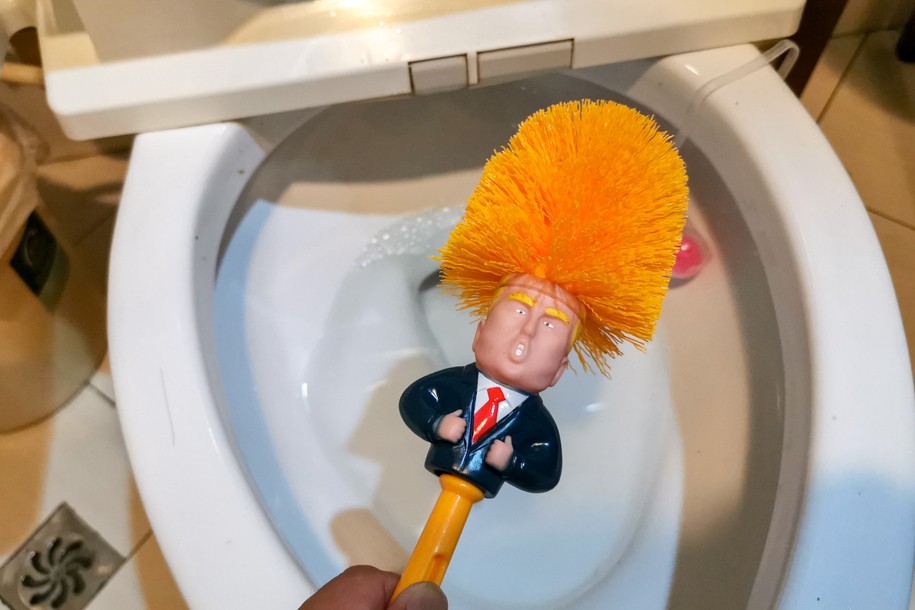
This photo taken on May 15, 2019 shows a Donald Trump themed toilet brush displayed at a home in Shanghai. The brushes, which sell for 23 Yuan (US $3.34) have become popular on online shopping platforms since a trade war between the US and China escalated in the past week. (Photo by STR / AFP) (Photo by STR/AFP via Getty Images)

Donald Trump was in Texas today, June 30. Something-something about the border. Who knows why he was there, really? Maybe he wanted to brag about the wall you can breach in a few minutes with a $100 reciprocating saw from Home Depot. Or maybe he wanted to remind Americans about his child-separation policy, which simply everyone loved. Ah, the good old days.

But what stuck out was this:

TRUMP: “They did a test. Did I ace it? I aced it, and I’d like to see Biden ace it. He won’t ace it. He’ll get the first two. There are 35 questions, and the first two or three are pretty easy. They’re the animals. Is this a lion, a giraffe? When he gets to around 20 he’s going to have a little hard time. I think he’s going to have a hard time with the first few, actually.”

Yup, that’s Donald Trump still bragging about the dementia test he passed, months after the fact.

Honestly, I’m more embarrassed for Texas Gov. Greg Abbott than for Trump. Trump does this shit all the time. It’s expected. But it must be horrifying to sit next to him and have to pretend he’s not the saddest salmagundi of insensate protoplasm and ear hair clippings in the known universe.

Seriously, who looks at a guy bragging about passing a dementia test—a test doctors give to people they suspect of having, erm, dementia—and thinks, “Yup. That’s my hero. Let’s follow him into the breach. If he leads us astray, well, at least we know he passed a dementia test a year ago. Can’t say we didn’t do our due diligence.”

It’s good to know our former pr*sident knows the difference between a lion and a giraffe. That’s heartening, and it certainly was never a given. But even if he isn’t showing signs of dementia—a big if—I’d argue it’s still pretty horrifying that he thinks this is some sort of feather in his cap. After all, if he thinks acing a dementia test is a big deal, how fucking stupid is he really?

"How could a guy have dementia who had a free Diet Coke button installed on his desk?  Really!  All I had to do was push it and I got a free Diet Coke.  That's not dementia.  That's genius."

Trump’s Weird War Against the States

Heather Digby Parton / Salon President Donald Trump. (photo: Andrew Harrer/Bloomberg/Gett...