Friday, April 3, 2026

Another big rat jumps Trump ship

 no image description available

Alex Jones speaks to the media after arriving at the federal courthouse in Houston, Texas, for a hearing in front of a bankruptcy judge in June 2024.
 
Alex Jones calls to dump Trump over busted brain and body 
"This is not funny, this is not good, but he’s gone and that’s it."

Conspiracy theorist Alex Jones told the viewers of his Tuesday broadcast that it is time to drop President Donald Trump as a leader of the conservative movement, citing failing health and mental decline.

Jones said recent images showing Trump’s swollen ankles were evidence of “heart failure” and that “he does look sick.”

“He does babble and sound like the brain’s not doing too hot,” Jones added. “We just cut bait on Trump, and we just mobilize against the Democrats.”

After over a decade of hailing Trump as a conquering hero for the right and at times arguing that Trump has been God’s instrument on Earth, Jones said he has been a “minor figure” in a purported conservative awakening that has occurred.

He added, “We need to be sad about Trump. This is not funny, this is not good, but he’s gone and that’s it.”

Jones also argued that Trump was under “evil control” and urged his viewers to pray for him.

Redness is visible on the neck of President Donald Trump waves as he speaks with reporters before departing on Marine One from the South Lawn of the White House, Friday, Feb. 27, 2026, in Washington. (AP Photo/Alex Brandon)
Redness is visible on President Donald Trump's neck while he speaks with reporters on the South Lawn of the White House on Feb. 27.

The (apparent) radical change of heart on Trump by Jones comes as the decision to attack Iran has continued to spiral out of control. Gas prices have skyrocketed, adding to global economic instability still reeling from Trump’s tariff policies. Jones has had to reconcile his position as a loud Trump cheerleader with his previous advocacy against military interventions.

For months, there has been visual evidence of numerous physical ailments from Trump, including markings on his neck and hands. There have also been multiple reports of considerable mental deterioration by Trump, with signs of cognitive decline and other serious slippages. Jones’ decision to suddenly notice these ailments—just as the Iran situation continues to worsen—raises serious questions about how authentic the conspiracy theorist’s concerns are.


Related | WTF is wrong with Trump's neck?


In Trump, Jones saw someone who shared his conspiratorial worldview achieve a level of prominence and influence never before seen. For instance, both men were prominent promoters of the racist birther conspiracy theory that alleged former President Barack Obama was born in Kenya and therefore ineligible for the presidency. Trump’s failures in office have significantly undermined the faith Jones has placed in him for years.

In addition to Trump’s collapse, Jones is experiencing a series of major career failings.

Just last month, during an apparently drunk appearance on fellow right-wing podcaster Tim Pool’s program, Jones said that his conspiracy website Infowars would be shutting down soon. Jones is facing millions in legal fees he has to pay out to the families and survivors of the Sandy Hook school shooting after he defamed them on his program.

Cartoon by Jack Ohman

Jones also lost key collaborator Owen Shroyer in a major dust-up last year, saw the Trump Department of Justice pull back on efforts to investigate Jones’ enemies, and he had to contend with Trump continuing to play cover for accused sex trafficker Jeffrey Epstein.

Conservatives seeking out right-wing pundits peddling outrage have begun to shift to younger and openly antisemitic figures like podcaster Nick Fuentes over figures like Jones, who has been in broadcasting for decades.

Jones could always pivot back to supporting Trump, because he has rarely held a consistent position on a host of topics. But his decision to call for a leadership change is a clear indicator of cracks in the core coalition that has been behind Trump for so long.



Wednesday, April 1, 2026

As Threats Rise, the Gulf Turns to Ukraine’s War-Tested Expertise

 As Threats Rise, the Gulf Turns to Ukraine’s War-Tested Expertise

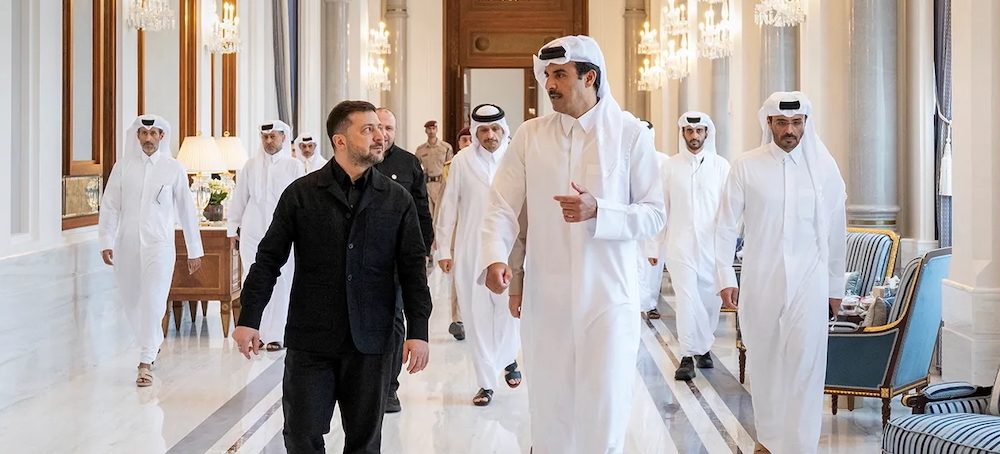
Leading the way: Ukraine has turned its experience into expertise. (photo: Reuters)
 
Zelensky’s Gulf tour suggests a shift from dependency to leverage, as Ukraine markets the defence capabilities that it has learned through war. 
 
Inzamam Rashid / Monocle

Ukrainian president Volodymyr Zelensky’s swing through Saudi Arabia, the UAE and Qatar this past weekend was billed as diplomacy. It was, more importantly, a sales trip and a rather deft one at that. 

In Jeddah, Abu Dhabi and Doha, Zelensky was not simply asking for sympathy, cash or a few more polite communiques. He was offering something rarer in 2026: a war-tested security product that these wealthy states suddenly need. 

Saudi Arabia signed a defence-co-operation arrangement with Kyiv; the UAE agreed a security and defence deal; and Qatar went further, signing a 10-year intergovernmental defence partnership that includes coproduction facilities and technological partnerships.

All of this matters because the Gulf is no longer insulated by distance, balance sheets or American hardware. Iranian attacks and the disruption around the Strait of Hormuz have made the region feel more vulnerable than it has in many years, while global oil markets have again been reminded that geography, not confidence, sets the terms. 

In Abu Dhabi, Zelensky and the UAE’s president, Sheikh Mohamed bin Zayed, discussed Iranian strikes, the Strait of Hormuz blockade and the effects on the oil market. In Doha, Zelensky and the Qatari leadership explicitly framed their talks around protecting life and preventing the regional war from expanding. Zelensky’s wager is that Ukraine can now market itself not just as a front-line democracy worth defending but also as a security donor in its own right. That is a notable shift.

Zelensky’s own formulation is blunt. “As a result of the war we are going through,” he wrote, “and because our enemy is extensively using the Iranian ‘Shahed’ drone technology, we have developed our own system.” He added that Ukraine is now sharing what it has built with countries in the Middle East and that “we have shifted the geopolitical landscape”. That might sound grandiose but it’s broadly true.

The real story is not that Zelensky has discovered what the Gulf can do for Ukraine. It is that the Gulf has discovered Ukraine in a new register. Riyadh, Abu Dhabi and Doha are accustomed to buying finished systems from Washington, Paris and London. Ukraine is pitching something different: battlefield know-how, fast adaptation, cheaper interception and production partnerships. 

Qatar’s agreement is the clearest sign of where this is heading. Coproduction is not diplomatic theatre – it is industrial policy. It suggests that at least some Gulf capitals have concluded that in an era of drones, missiles and uncertain supply chains, sovereignty depends as much on manufacturing lines and software integration as on flashy procurement announcements.

There is, admittedly, a moral queasiness to all this. Zelensky is effectively arbitraging one war into leverage for another. He is doing so while the Middle East is already under attack and while Ukraine still depends on outside support to survive Russia’s invasion. Yet it would be naive to pretend that there is a better option. The West is distracted, arsenals are stretched and Kyiv needs cash, investment and air-defence depth. If Europe has been slow and the US erratic, then Zelensky is right to look for buyers and benefactors.

Still, charm offensives can curdle into overreach. Ukraine’s greatest asset is its credibility, earned at a terrible cost. If Kyiv begins to sound too pleased with its new role as a merchant of wartime expertise, it risks blurring the line between resilience and commodification. 

Zelensky should be careful here. The pitch works best when it is sober: Ukraine understands the Shahed threat because it has lived under it and it can help others to prepare.

Even so, the Gulf tour looks like one of Zelensky’s most intelligent diplomatic gambits. He arrived not as a supplicant but as the head of a country that has turned necessity into exportable expertise. And in an age when wars bleed into markets, infrastructure and logistics, this is a practical form of statecraft. Kyiv is still fighting for survival. But in Saudi Arabia, the UAE and Qatar, Zelensky has shown that survival, if managed properly, can itself become a business model.

Ukraine to the rescue!


Another big rat jumps Trump ship

  Alex Jones speaks to the media after arriving at the federal courthouse in Houston, Texas, for a hearing in front of a bankruptcy judge ...